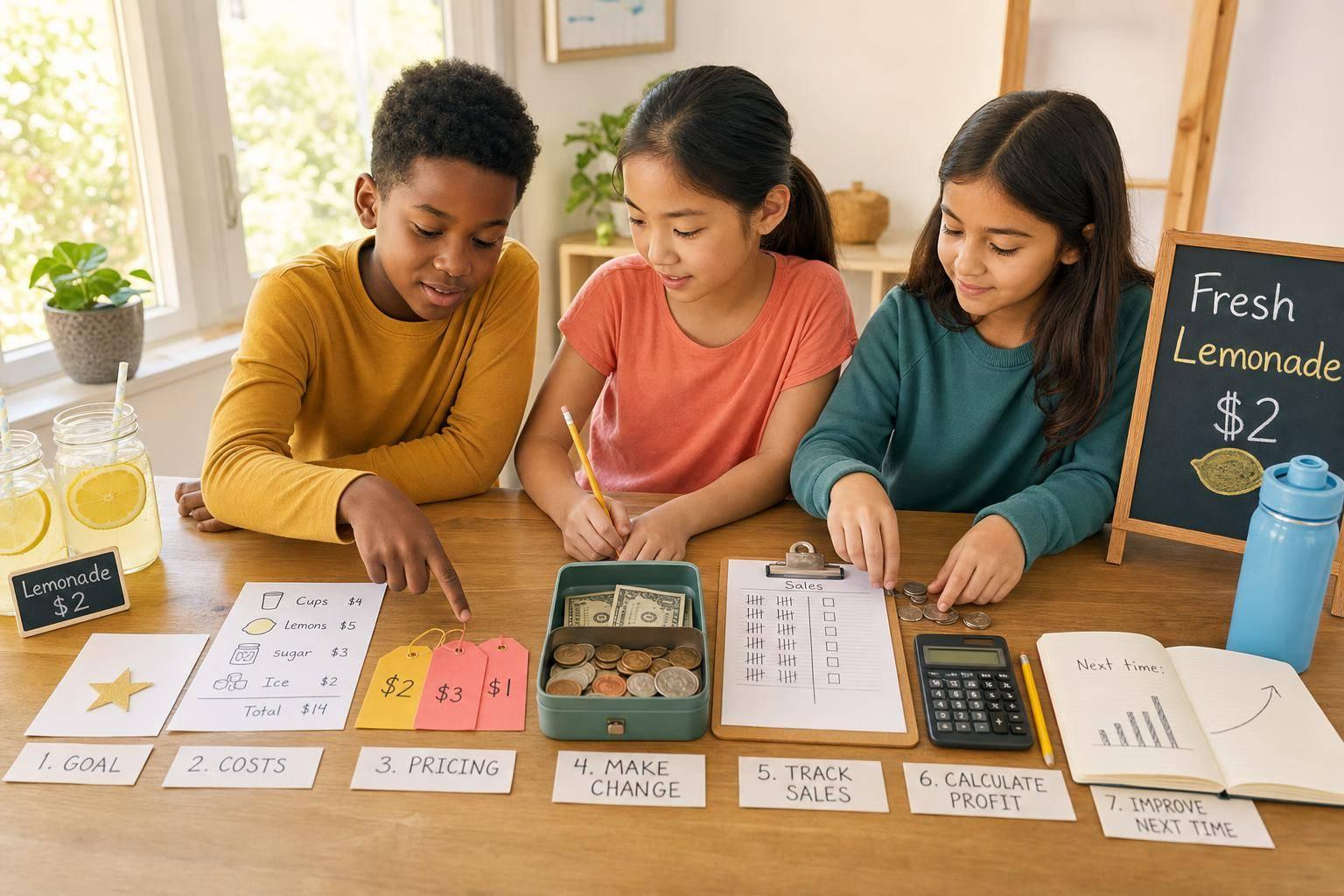

If you want a kid-run business to teach more than just how to make money by turning everyday tasks into business lessons, start with home rules. Clean up after work, speak kindly to customers, split each sale, finish one task at a time, and keep work time separate from play time.
These five rules help kids build habits they can use right away. A short selling block, a 3-jar money system, and a basic checklist can teach follow-through, focus, and money sense. For example, splitting a $30 sales day into jars can help a child see where each dollar goes instead of spending it all at once.
- Clean up the work area so the next sales session starts on time
- Use kind, clear words so customers know what the child is selling
- Save part of every sale with simple jars like Spend, Save, and Business
- Finish one task before the next to cut mistakes
- Separate work time and play time with a set schedule, like Saturday, 2:00–4:00 p.m.
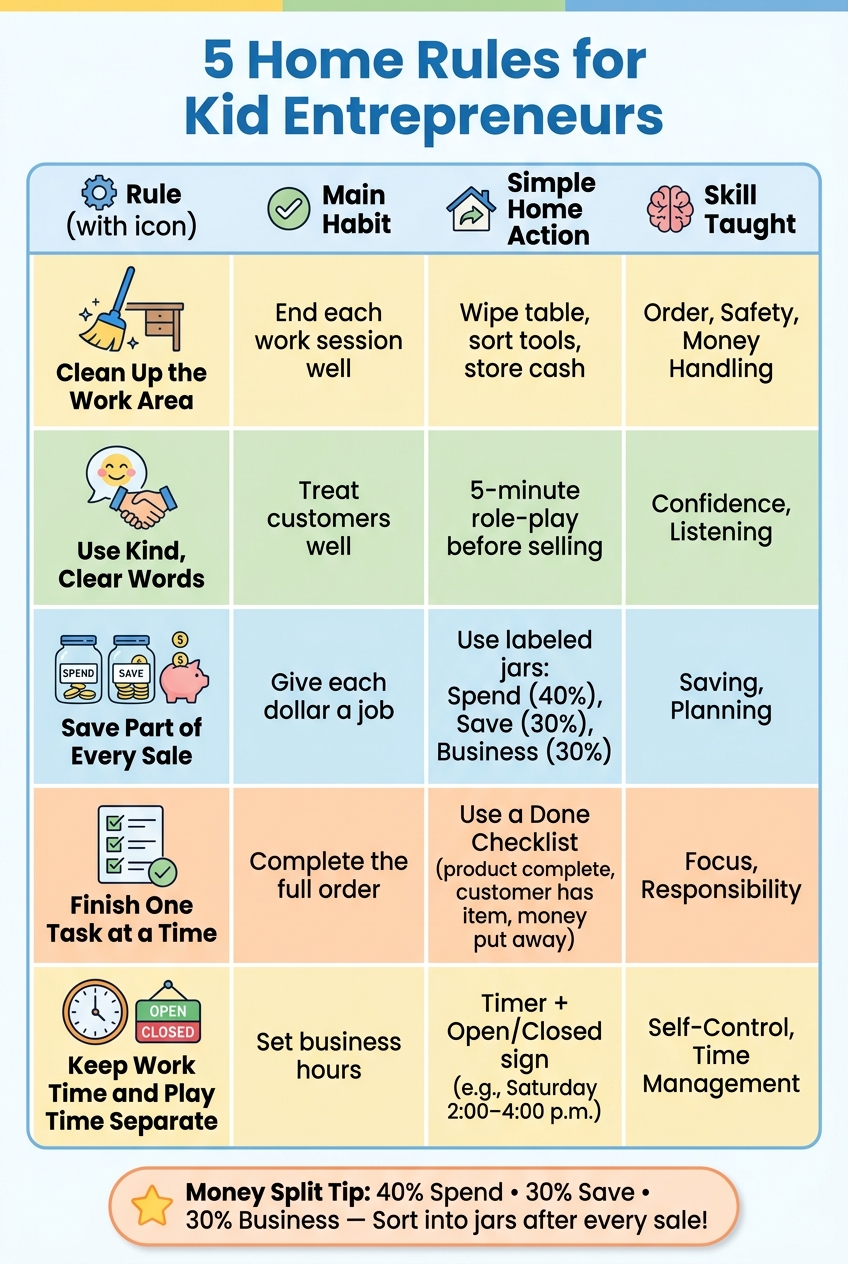
5 Home Rules for Kid Entrepreneurs: Habits, Actions & Skills
Quick Comparison
| Rule | Main habit | Simple home action | Skill taught |
|---|---|---|---|
| Clean up | End each work session well | Wipe table, sort tools, store cash | Order, safety, money handling |
| Speak kindly | Treat customers well | 5-minute role-play before selling | Confidence, listening |
| Split each sale | Give each dollar a job | Use jars or envelopes | Saving, planning |
| Finish one task | Complete the full order | Use a checklist or one tray | Focus, responsibility |
| Separate work and play | Set business hours | Timer and Open/Closed sign | Self-control, time use |
Why Home Rules Matter for Kids Learning Business
Kids don’t pick up business skills from one talk or one big lesson. They learn by doing the same things over and over until those actions become normal. That’s where home rules help. They turn basic business lessons into everyday habits.
Home rules make those habits automatic. When kids keep practicing the same expectations - cleaning up, speaking kindly, finishing tasks - business skills start to feel like part of regular life. That takes some pressure off and helps the lessons stick.
It also helps to keep the focus on effort, not outcomes. Set rules around what kids can control: try again when something doesn’t work, stay with the task, and learn from small mistakes. Don’t make the rule “sell everything no matter what.” When kids know the point is to learn, not to be perfect, they’re more willing to test ideas and have fun with the process.
A hands-on kit like My Lil Startup gives kids a simple business they can set up, run, and clean up. It gives them a ready-made way to put those rules into action. Clear steps make it easier for kids to get started and try again the next time.
The five rules below turn those habits into simple daily practice.
1. Clean Up the Work Area Before Moving On
Business Habit
Cleaning up ends the workday and gets the space ready for the next sale. It’s part of the job, not an extra step. Put supplies away, wipe the table, and store finished products before the session ends.
Simple At-Home Routine
A simple home routine works well:
- Sort supplies into labeled containers
- Wipe the table and throw away trash
- Put main supplies back in one set spot
- Do a 1-minute check for anything missing or broken
That keeps the business area neat, safe, and ready to use.
Skill It Teaches
This habit teaches organization, safety, and money handling. Kids start to learn where tools go, how to keep their workspace safe, and why cash should go back to one place after each sale.
Example for Ages 6–12
A 9-year-old starting a slime business at home finishes a work session by putting finished slimes in a labeled bin, returning glitter and charms to their containers, wiping the table, and placing the cash box and notebook in a drawer. The next day, the table is ready if a neighbor wants to buy.
If your child uses My Lil Startup, give each item a set storage spot so cleanup stays fast. That’s a business habit.
2. Use Kind, Clear Words With Customers
Business Habit
The way kids speak to customers matters just as much as the product they sell. Kind, clear words help build trust and make people feel respected. A simple pattern works well: greet the customer, share one detail about the product, and say thank you. It gives kids a plan to follow without making them sound stiff or rehearsed.
Simple At-Home Routine
A short 5-minute role-play before selling can go a long way. A parent, sibling, or caregiver can play the customer while the child practices a greeting, explains the product in one or two sentences, and ends with a thank-you. It helps when adults model a calm, friendly tone. After a few rounds, the words start to feel natural instead of forced.
Skill It Teaches
This habit helps kids build listening skills, self-control, and confidence. When they speak in a clear, friendly way, customers are more likely to respond well. It also makes the next step easier, especially when it’s time to handle money after the sale.
Example for Ages 6–12
A child selling slime might say: "Hi! I make colorful slime. This one costs $2. Would you like to buy one?" If the customer says no, the child can still stay polite and end with "Thank you!"
Kids using the My Lil Startup Slime Business Kit can also add a handwritten thank-you card with each sale.
3. Save Part of Every Sale
Business Habit
Teach kids to handle each dollar with a plan, not blow through it the minute they earn it. A simple way to do that is to split every sale into Spend, Save, and Business money before any of it gets used. Set the split before the first sale so there’s no guesswork later.
Simple At-Home Routine
Right after each sale, sort the money. Use three jars or envelopes labeled Spend, Save, and Business. A good starting split is 40% for Spend, 30% for Save, and 30% for Business.
Keep the jars where kids can see them, like on a kitchen shelf or at their workspace. That way, sorting money feels like part of cleanup, not some extra chore tagged on at the end.
Skill It Teaches
This habit helps kids practice saving, planning, and putting money back into their work. Business money can pay for supplies and flyers. Save money can go toward a goal they care about.
Example for Ages 6–12
Say a 9-year-old sells 10 slimes at $3 each and earns $30 in one afternoon. With a 40/30/30 split, they put $12 in Spend, $9 in Save, and $9 in Business. For kids ages 6–8, keep it even simpler with two jars: half Spend and half Save.
The My Lil Startup Slime Business Kit includes a sales tracker that fits neatly into this routine. Kids can log each sale, then use those numbers to figure out how much goes into each jar. That makes money-splitting part of the job from the start. Once the money is sorted, the sale is done, and they can move on to the next task.
4. Finish One Task Before Starting Another
Business Habit
Once the money is sorted, the next rule is simple: finish the whole job before starting the next one.
Jumping between tasks can lead to missed orders, counting mistakes, and sloppy products. That’s why businesses aim to finish one order before moving on to another. For kid entrepreneurs, that means: make the product, package it, hand it to the customer, and then start the next order.
At home, the same idea works well. Stick with one task at a time until the sale is fully done.
Simple At-Home Routine
Set up a Done Checklist on a whiteboard or a sheet of paper near the workspace:
- Product is complete and looks good
- Customer has the item
- Money is counted and put away
A child should check off all three before moving to the next customer or starting a new product.
For younger kids, try a One Tray Rule. Put all materials for the current task on one tray. When the tray is cleared, they can move on.
This matters because it teaches kids to finish strong.
Skill It Teaches
This rule builds focus, responsibility, and time sense.
When kids finish tasks instead of bouncing back and forth, they get a better sense of how long work takes. They also start to see the link between their effort and the customer’s experience. A half-finished order lets down someone who already paid.
Example for Ages 6–12
For ages 6–8, use pictures for each step: choose and label the product, add decorations, hand it to the customer, and place the money in the jar. If they try to skip ahead, gently guide them back to finishing this customer’s order before starting the next slime.
For kids ages 9–12, add one more step at the end: deliver the slime, include a thank-you card, then log the sale before starting the next one. The My Lil Startup Slime Business Kit helps with this by including a sales tracker, thank-you cards, and step-by-step instructions that turn each customer interaction into a clear task with a finish line. Update the tracker last so record-keeping becomes part of every sale.
Once work is done, it should stay work time only.
5. Keep Work Time and Play Time Separate
Business Habit
Once one job ends, the next habit is setting clear business hours. A kid-run business needs a clear start time and stop time. During work time, kids make products, help customers, and track money. During play time, the business supplies get put away.
That split matters. It helps kids focus on the task in front of them and keeps the whole thing from feeling like too much.
Simple At-Home Routine
Set one regular business block, like Saturday from 2:00–4:00 p.m. Put out an Open/Closed sign and use a timer. When the sign flips to Closed, everything gets packed away.
It’s a small routine, but it sends a clear message: now we work, now we stop.
Skill It Teaches
This habit builds self-control and time management. Kids learn that work has an end point. They also learn they can come back to it later instead of letting it spill into the rest of the day.
Example for Ages 6–12
For ages 6–8, keep business blocks short - about 20 to 30 minutes - and use a timer to mark the end. For ages 9–12, you can use a longer shop window, then pack the whole kit away when time is up. The My Lil Startup Slime Business Kit works well for this because the supplies come out during business hours and go back into storage after.
A Simple Money-Splitting Guide for Kids
Once the money is counted, make the next step easy with a simple split: 40% Spend, 30% Save, and 30% Business. This follows the same money habit from Rule 3, but breaks each dollar into clear jobs.
Here’s the idea:
- Save is for later
- Spend is for now
- Business goes back into supplies
For a slime business, Business money can pay for new colors, decorations, or flyers.
After each sale, count the total and sort the cash into three labeled jars or envelopes. For younger kids, start with just Save and Spend. Then add Business when that feels easy. For older kids, tweak the split if needed.
Once the cash is sorted, ask a few simple questions: What are you saving for? What do you want to spend on? What does the business need next?
That helps the child see where the money is going before the next sale.
Conclusion
These five rules take everyday home habits and turn them into simple business habits: clean the work area, speak kindly to customers, save part of each sale, finish one job before jumping to the next, and keep work time separate from play time.
Consistency matters more than perfection. Kids learn by doing the same small habits again and again, then getting back on track after an off day. That’s where the growth happens. Each rule helps build a skill that sticks - follow-through, confidence, and money sense. Over time, those habits help kids become more confident, responsible, and independent.
For kids using a My Lil Startup slime business kit, tools like the sales tracker, thank-you cards, and flyers support all five of these habits in a direct, practical way.
Start small. Pick one rule this week. When that feels easy, add the next one. Bit by bit, those routines turn into confidence and independence.
FAQs
Which money split should I use?
Encourage your young entrepreneur to split earnings into three buckets: save, spend, and donate. A few jars or containers can make this feel concrete and easy to follow.
If they’re running a business, have them put money into savings first. Then set aside part of what they earn to put back into the business. For example, they might use half to buy more inventory and help the business grow.
How can I adapt these rules for younger kids?
Keep lessons hands-on and tasks simple. Visual tools like progress charts or jars can help kids track money and chores, and big goals feel less intimidating when you split them into smaller steps.
Role-play is also a great way for younger kids to practice social skills and customer interactions. You can fold the rules into daily routines so they build skills bit by bit, without feeling overloaded. That way, the whole thing stays fun and rewarding.
What if my child loses interest or gets distracted?
Simplify their routine and give it a clear shape. Break big business projects into smaller tasks so they don't feel overwhelmed.
Use timers, schedules, and visual progress charts to help them stay focused and work on their own. If they're taking on too much, help them block out set times for business tasks, play, and school during the parts of the day when they work best.