
Yes - kids ages 6–12 can sell online, but a parent needs to run the account, payments, and messages. The short version is simple: kids make and pack the product, parents handle money and privacy, and families should start with a small product list, local pickup, and a basic sales log.
If I were explaining this fast, I’d say the article comes down to four things:
- E-commerce means selling online instead of at a slime vs lemonade stand
- An online store shows products, prices, carts, and payments
- Parents handle safety, account setup, and customer contact
- Kids handle product ideas, shop style, packing, and sales notes
A simple example in the article is a slime business:
- Start with 3–5 slime types
- Set each slime at $5.00
- Sell 20 slimes for $100.00 total
- Begin with pickup or hand-delivery to keep shipping simple
- Track orders with notes like Jul 27, 2026 - Shipped
The article also uses My Lil Startup’s Slime Business Kit as a starter example:
- Price: $39.95
- Includes: 20 pre-made slimes
- Extras: glitter, charms, beads, glow powder, flyers, thank-you cards, and a sales tracker
- Goal marker: open a sealed envelope after $50 in sales
The main point: keep the store small, keep parent supervision in place, protect private details, and let the child focus on making, naming, packing, and learning how sales work.
That gives you the full picture up front before the article goes step by step.
How a 6 year old made $87 with her online shop
What Parents Handle and What Kids Can Do
Now that you know what an e-commerce platform does, here’s how families usually split the work.
A kid-run online business tends to work best when the parent handles the account, money, and customer contact, while the child takes the lead on the fun part: making products and shaping how the shop looks and feels.
Parent Responsibilities: Accounts, Payments, and Privacy
A parent should own the store account, along with any payment or bank account connected to it. Parents should also handle customer messages and check any marketing materials before they’re shared.
One rule matters a lot: never post a child’s full name, home address, or birthday in a product listing, message, or social post.
Here’s a simple way to split the work:
| Task | Parent | Kid |
|---|---|---|
| Account Setup | Owns the store account | Picks the name and logo |
| Payments | Handles payments and records | Tracks sales totals |
| Privacy | Sends messages from customers | Writes product descriptions |
| Shipping | Oversees delivery | Packs orders and writes thank-you notes |
| Inventory | Buys supplies | Counts stock and reports low items |
Kid Responsibilities: Products, Creativity, and Tracking
Kids can make products, name them, decorate them, and keep an eye on sales. That gives them a hands-on way to learn how a business works without putting them in charge of the parts that need adult oversight.
Ages 6–9 may do best focusing on making items like slime or lemonade. Ages 10–12 can often help with return customers and simple recordkeeping with a parent nearby. A plain notebook is often enough for tracking sales.
With roles set, the next step is picking simple products, prices, and delivery options.
How to Start a Simple Online Slime Business
Choose Products, Prices, and Delivery Options
Once the roles are set, it’s time to keep the store simple.
Start with three to five slime types. Give each one a clear, easy name. Sticking with three to five themed names makes the shop feel organized without turning setup into a mess. Price each slime at $5.00. At that price, selling all 20 slimes from a starter kit brings in $100.00 total.
For delivery, keep it local at first. Pickup or hand-delivery is the easiest way to start.
Once the product list is ready, the next step is turning those ideas into a first storefront.
Use My Lil Startup to Turn a Slime Idea Into a First Store
My Lil Startup sells a Slime Business Kit for $39.95 that comes with 20 pre-made slimes and decorations like rainbow glitter, charms, beads, and glow-in-the-dark powder. It also includes product, packaging, marketing, and sales tracking tools in one kit.
That setup makes the business feel hands-on instead of abstract. Each item has a clear job:
| My Lil Startup Kit Contents | E-Commerce Use |
|---|---|
| 20 Pre-made Slimes | Product inventory |
| Glitter, Charms, Beads, Glow Powder | Product variations |
| 10 Promotional Flyers | Marketing |
| 20 Thank You Cards | Packaging |
| Sales Tracker | Sales tracking |
| Instruction Book & Sales Tips | Planning and descriptions |
| Top Secret Envelope | Milestone reward for reaching a sales goal |
The Top Secret Envelope adds a simple target. Keep it sealed until sales reach $50.
How Online Orders, Payments, and Delivery Work
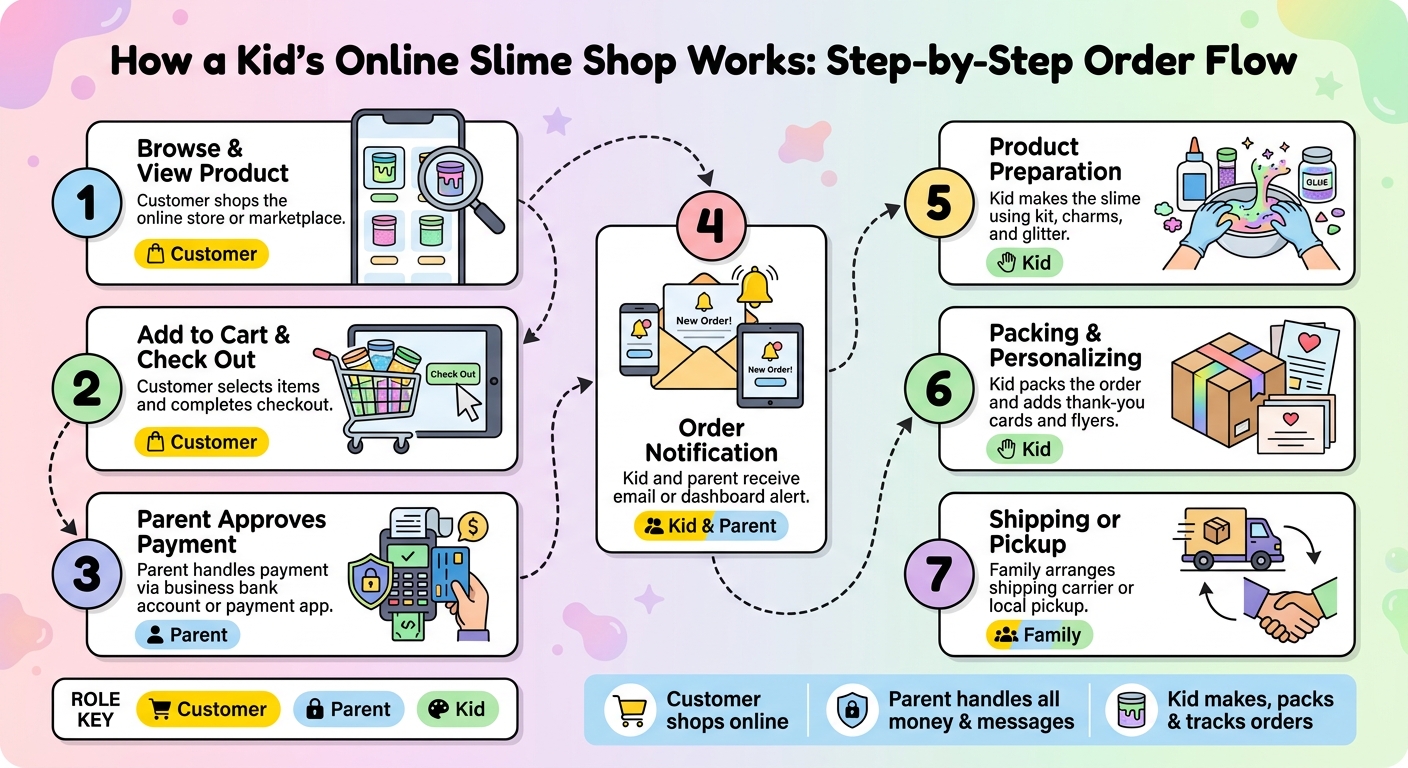
How a Kid's Online Slime Shop Works: Step-by-Step Order Flow
The Order Process, Step by Step
Once the store is live, each order moves through a simple flow.
| Online Order Steps | Who Does It | Tool Used |
|---|---|---|
| 1. Browse & view product | Customer | Online store or marketplace |
| 2. Add to cart & check out | Customer | Online store or marketplace |
| 3. Parent approves payment | Parent | Business bank account or payment app |
| 4. Order notification | Kid & parent | Email or e-commerce dashboard |
| 5. Product preparation | Kid | Slime kit, charms, glitter |
| 6. Packing & personalizing | Kid | Shipping box, thank-you cards, flyers |
| 7. Shipping or pickup | Family | Shipping carrier or local pickup spot |
The flow is pretty straightforward: the customer shops, the parent handles the money, and the kid makes the slime.
That split matters. It keeps the business organized and helps kids stay focused on the hands-on part of the shop instead of dealing with bank or card details.
A small extra, like a thank-you card, can make the order feel more personal and give customers a reason to come back.
Payments, Shipping Costs, and Order Tracking
Parents should handle all payment details. Kids should never type in card numbers or bank account information.
Shipping can eat into profit fast, so local pickup is often the easiest place to start. It cuts costs, keeps things simple, and makes early orders easier to manage.
For tracking, families can log each slime order so nothing slips through the cracks. Use the U.S. date format, like Jul 27, 2026 - Shipped or Jul 27, 2026 - Delivered. The Sales Tracker included in the My Lil Startup kit gives kids a place to record every order.
Safe Habits and a Simple First Goal
Rules That Keep Kid E-Commerce Safe
Once the store is live, a few clear rules make things much easier to handle. Stick with three: parent-managed accounts, supervised messages, and private personal details.
Kids should use accounts run by a parent, check with a parent before accepting any order, and never share a home address, phone number, or school name. That puts adults in charge of the account side of the business while kids stay focused on making products. Customer messages should also stay supervised at all times.
For ages 6–9, keep sales limited to family, friends, and neighbors.
Conclusion: Start Small, Track Sales, and Keep It Fun
With those safety rules set, the next step is simple: pick one small first goal.
A small slime shop can teach kids how pricing, profit, and customer care work in everyday business. Parents manage the accounts and payments. Kids take care of the hands-on work and simple sales tracking.
My Lil Startup's Slime Business Kit gives families a simple way to begin with 20 slimes, a tracker, and marketing materials. The sealed "top secret" envelope - opened only after reaching $50 in sales - adds a clear goal and gives kids something fun to work toward.
The point is to learn, not to get every detail perfect. Start small, track sales, and keep it fun.
FAQs
How much profit can a kid make per slime?
Profit per slime comes down to two numbers: what it costs you to make it and what you sell it for.
If one slime costs $2.00 to make and sells for $5.00, your profit is $3.00 per slime.
To figure out your profit, subtract your total ingredient and supply costs from the price you charge. If you can bring down your cost per slime, your profit goes up. That can include using a My Lil Startup kit to help keep costs lower.
What should a parent do before the first sale?
Before the first sale, parents should help get things set up so the business is safe and ready to go. That means helping with a simple business plan, setting up a clean workspace, and teaching basic hygiene.
Parents also need to take care of the legal and financial side. They should check local permit and tax rules, and oversee product descriptions, packaging, and quality checks.
When should a kid start offering shipping?
A kid should think about offering shipping after they’ve gotten comfortable with the basics of in-person sales and feel ready to sell to more people.
Why wait a bit? Because shipping comes with extra moving parts. There’s packing, labeling, tracking, and making sure orders arrive the way customers expect. It usually makes more sense after a child has some experience with local sales, keeping track of inventory, and talking with customers face-to-face.
For My Lil Startup users, this can be a natural next step once they’ve hit a few early sales milestones.