

If you want the easiest start for a kid business website, buy the domain and hosting from the same company. For most small sites, that means fewer setup steps, one support team, and one bill to track.
Here’s the short version:
- Same company: lower first-year cost in many cases, faster setup, simpler support
- Two companies: more setup work, two support contacts, but more control over the domain later
- Best fit for most first sites: one company
- Best fit for a long-term brand: separate domain and hosting accounts
A domain is the web address. Hosting is where the site files sit. You need both to put a site online.
In many cases, bundled plans look cheaper at first, but renewal prices can jump after year one. That’s why you should check three things before paying:
- Renewal pricing
- Who owns the domain
- How easy it is to move hosting later
Finally Understand Domains, Hosting & Websites (No Tech Talk Needed)
Quick Comparison
| Factor | Same Company | Separate Companies |
|---|---|---|
| Year 1 cost | Often lower upfront | Split into two bills |
| Setup | Fewer steps | One extra connection step |
| Support | One team | Two teams |
| Renewals | One schedule | Two schedules |
| Domain control | Lower | Higher |
| Best use | First small site | Long-term brand plan |
Bottom line: if you just want to get a kid site live without much hassle, keep domain and hosting together. If you care more about keeping the brand name in a separate account for years, split them.
Buying Domain and Hosting From the Same Company
Buying your domain and hosting from one company keeps things simple. You get one account, one bill, and fewer moving parts to deal with. For a small kid-run business that just needs a basic website, that's often the easiest way to get started.
Faster Setup and Simpler Support
The biggest plus is the setup. With many all-in-one providers, the domain connects to the hosting on its own. No digging through DNS settings. No manual steps. You can get the site live faster, which is a big deal when you just want things to work.
Support is simpler too. If something goes wrong, you don't have to guess whether the issue is with the domain company or the hosting company. One team handles both.
That said, easy setup at the start doesn't always mean the best deal later. Pricing can change after the first year.
First-Year Discounts vs. Higher Renewal Prices
Bundled plans often cost less in year one. That's the hook, and it can save money upfront. But renewal prices are often higher, so it's smart to check the renewal rate before you buy.
A low starting price can look great on the surface. Then the second bill shows up, and it feels like a curveball.
Best for a First Kid Site
This setup makes the most sense for a first kid site that needs to go live fast. If the goal is to launch without a lot of setup or back-and-forth, an all-in-one provider is usually the smoothest option.
All-in-one at a glance:
| Factor | All-in-One (Same Company) |
|---|---|
| Price (Year 1) | Often lower from bundling |
| Price (Renewal) | Often higher after renewal |
| Setup Time | Fast - automatic connection |
| Support | Simple - one support team |
| Account Control | One account |
Next, compare that with keeping the domain and hosting separate.
Buying Domain and Hosting From Two Separate Companies
This setup means buying the domain from one company and hosting from another. It takes a bit more work at the start, but it can give parents more control over time. The downside is that support is split between two companies, so fixing problems can take longer.
For a simple kid business, this setup matters most when parents want to protect the brand name for the long haul.
More Steps at Setup, but Still Doable
The process is pretty simple: buy the domain, buy the hosting, and connect the domain to the hosting account. After that, there’s usually a short wait while the domain points to the host. That extra connection step is the main tradeoff for the added control.
Another plus: domain and hosting renew on separate schedules. That makes it easier for parents to see what each service costs, instead of paying one bundled renewal.
Better Long-Term Control of the Domain
When the domain sits in its own account, it stays separate from the website files. That gap can help protect the domain if the hosting account changes later. It also lets parents keep the domain account apart from day-to-day site edits.
Best Fit for a Kid Brand Parents Want to Keep for Years
This setup works well for a kid brand parents want to keep for years. Since the domain stays separate, switching hosting later is much easier because the brand name doesn’t have to move with it. That can save a lot of hassle down the road.
For most parents, the choice comes down to short-term ease versus long-term control.
| Factor | Separate Companies | Same Company |
|---|---|---|
| Setup Steps | Higher - one extra setup step | Lower - fewer steps |
| Long-Term Flexibility and Future Changes | Higher - hosting can change without moving the domain | Lower - less separation if you want to change hosts |
| Account Separation | Stronger - domain and hosting stay separate | Lower - less separation between accounts |
Next, compare both setups side by side for cost, ease, support, and control.
Side-by-Side Comparison for U.S. Parents
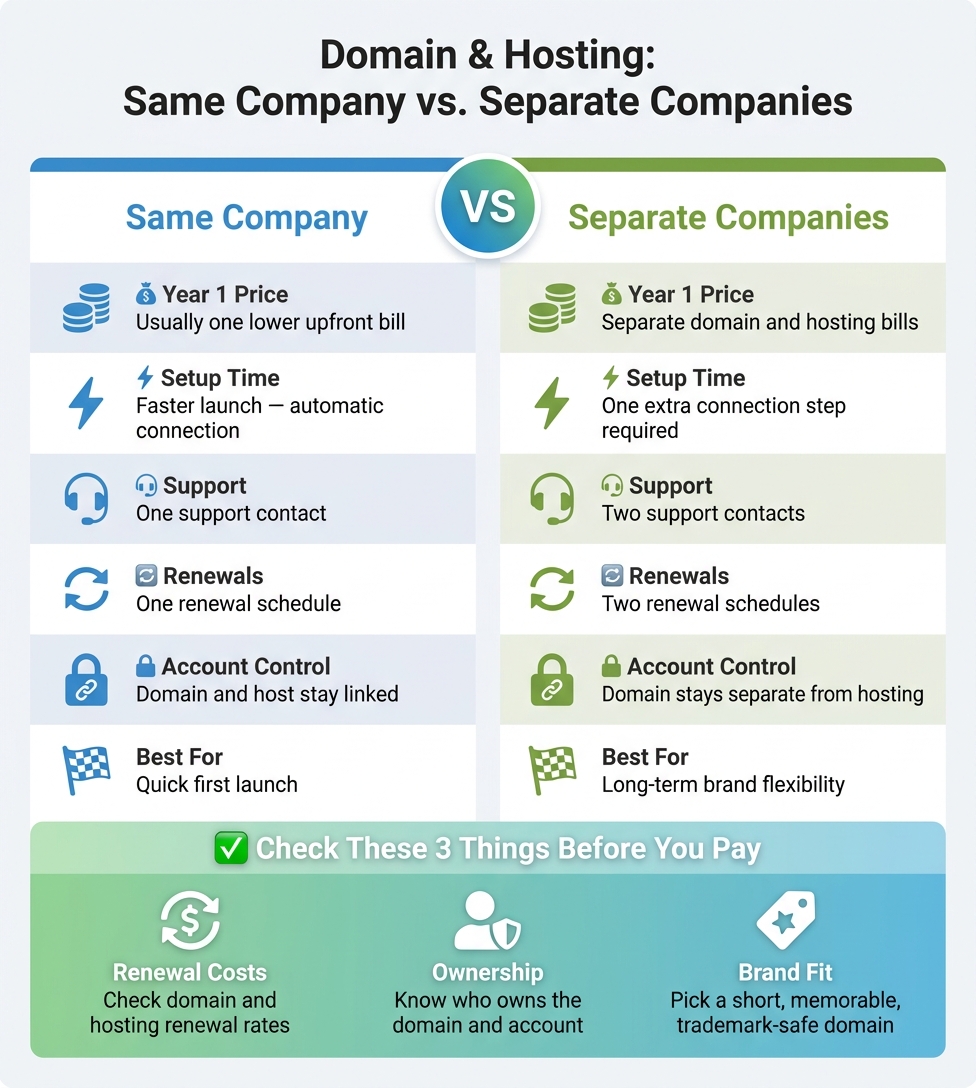
Domain & Hosting: Same Company vs. Separate Companies
After looking at each setup on its own, here’s the shortest way to compare them. For U.S. parents, the choice usually comes down to fast setup versus long-term control.
| Factor | Same Company | Separate Companies |
|---|---|---|
| Price (Year 1) | Usually one lower upfront bill | Separate domain and hosting bills |
| Setup Time | Faster launch | Requires one extra connection step |
| Support | One support contact | Two support contacts |
| Renewals | One renewal schedule | Two renewal schedules |
| Account Control | Easy to start, but the domain and host stay linked in one account | More control because the domain stays separate from hosting |
| Long-Term Fit | Good for a quick first launch | Better for a brand parents want to keep flexible over time |
Use the quick take below to match the setup to your goal.
Which Option Is Cheaper and Easier in Year 1
For a first launch, the same-company option is usually the easier path. All-in-one bundles are made to help kids get started fast, and bundled pricing makes first-year costs easier to track.
Which Option Is Easier to Manage Long Term
A bundled setup helps you launch fast. Separate accounts give you more room to move later. If speed matters most, go with the bundled setup. If flexibility matters more, keep the domain and hosting separate.
That tradeoff leads straight to the best overall choice for most small kid-run sites.
Conclusion: What Most Small Kid-Run Businesses Should Choose
After looking at speed, support, and control, the simplest path usually makes the most sense for first-time kid sites. Buying the domain and hosting from the same company is usually the better choice because setup is faster and support is easier to deal with. That can make launch day feel a lot less messy. If you want speed, go with one company. If you want more long-term control, use separate accounts.
If the site might turn into a lasting brand, sort out ownership and renewals now, not later.
Before you commit, check these three things:
- Renewal costs: Review domain and hosting renewal rates before you sign up so the budget stays manageable.
- Ownership: Write down who owns the domain and who can access the account.
- Brand fit: Pick a short, easy-to-remember domain and check for trademark issues.
The bottom line: Simple launch. Clear ownership. Protected brand. For most small kid-run businesses, choose the setup that’s easiest to launch and maintain.
FAQs
How do I know who owns a domain?
Do a WHOIS lookup to check a domain’s registered owner, contact details, and registration date. Most registrars have a simple search tool: type in the domain name, and you can view the available record.
If the owner has privacy protection turned on, their personal contact details may be hidden. In that case, you’ll usually see the registrar’s information instead.
Can I move hosting later without changing my domain?
Yes. You can move your website hosting to a different provider without changing your domain name.
Your domain is your site’s address. Hosting is the place where your website files live.
So if you switch hosting companies, your domain stays the same. You just update your domain’s settings so it points to the new server.
What renewal costs should I check before buying?
Before you buy, check the renewal price for your hosting. The first-year deal can look cheap, but the price often jumps when it renews. Do the same for your domain. That yearly renewal fee is easy to miss.
It also helps to look past launch costs. If you sell online, factor in payment or transaction fees, along with any required subscriptions and other overhead. That way, you’re looking at the full cost to keep the site running, not just the upfront price.