

Helping kids develop leadership through entrepreneurship is about teaching responsibility, communication, and problem-solving. These skills not only build their confidence but also prepare them for life's challenges. Here's a quick guide to fostering leadership in young entrepreneurs:
- Responsibility: Assign specific tasks like managing inventory or tracking sales. Let them handle challenges independently to build accountability.
- Communication: Teach them to interact confidently with customers using clear pitches and active listening. Role-play scenarios to practice handling objections.
- Teamwork: Encourage collaboration by assigning roles, resolving conflicts calmly, and ensuring everyone feels included.
- Problem-Solving: Guide them to brainstorm solutions during setbacks and stay calm under pressure.
- Goal Setting: Help them set clear, measurable goals and create a schedule to manage time effectively.
- Empathy: Teach them to value others' contributions and build trust with teammates and customers.
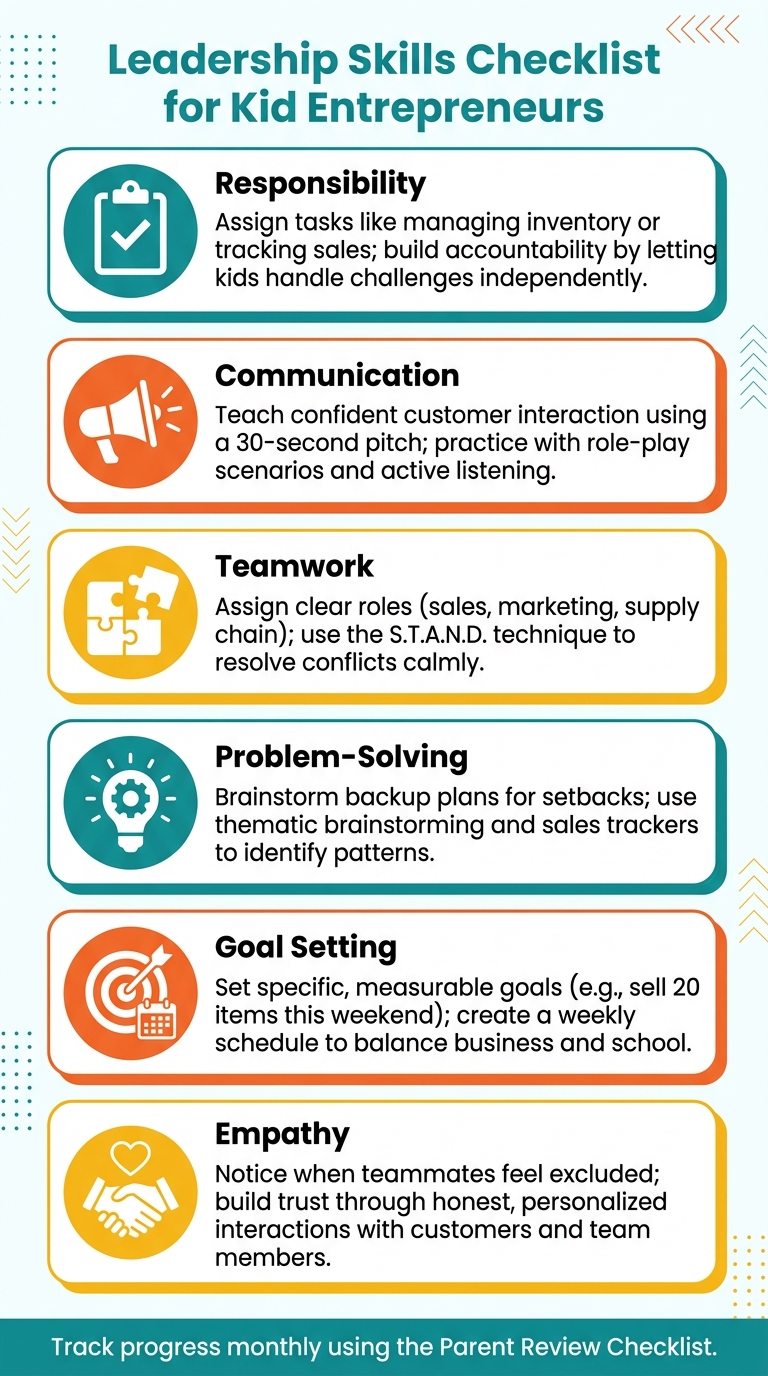
Leadership Skills Checklist for Kid Entrepreneurs
Kids Are Ready Now: Teaching Leadership & Entrepreneurship in Early Childhood
sbb-itb-a46f019
Encouraging Responsibility
Responsibility is at the heart of leadership. To lead others effectively, you first need to manage yourself. This starts with personal accountability and grows into the ability to handle responsibilities independently. Teaching kids this skill lays the groundwork for their decision-making and leadership abilities.
Teaching Kids to Own Their Tasks
Assigning specific roles in a business is a great way to help kids take ownership of their responsibilities. Let them handle tasks like managing inventory, setting up sales booths, processing customer orders, or tracking supplies. As Magnolia Potter explains:
"It's tempting to take over burdensome tasks like legal forms and financial activities... but you must let your child learn to handle those responsibilities on their own."
Even tasks that seem too advanced can be broken down into manageable steps. For instance, if your child runs a slime business, let them count inventory, decide when to reorder supplies, and track sales. Tools like the My Lil Startup Slime Business Kit include features like sales trackers, which give kids a hands-on way to manage these responsibilities.
The complexity of tasks should match your child's age and abilities. A younger child, say 6 years old, might choose between two booth layouts, while an older child, like a 10-year-old, can take charge of setting up the booth and handling customer payments.
Building Consistency and Accountability
Consistency is key to building accountability. Encourage this by helping your child create a simple checklist for their tasks. Let them manage it independently, which reduces the need for constant reminders and helps them take control of their responsibilities.
When challenges arise, resist the urge to step in immediately. Instead, ask them, "What do you think we should do?" This approach encourages problem-solving and critical thinking, skills they'll need to manage tasks on their own.
Celebrate their successes, especially when they handle tough situations. April Taylor, host of the Junior Moguls podcast, highlights the importance of tying positive feedback to identity: "I noticed how you stayed calm when things got difficult, that's what leaders do." This kind of affirmation helps kids see themselves as capable and responsible, reinforcing the habits they need to tackle bigger challenges in the future. Consistent task ownership strengthens their foundation for leadership.
Improving Communication Skills
Effective communication is a cornerstone of leadership. When kids can clearly express what they're offering, understand customer needs, and respond confidently, they build trust - the kind that encourages people to return.
Practicing Customer Interaction
Confidence in communication grows with consistent practice. A great starting point is teaching your child the Three-Part Mogul Introduction: share who they are, explain the problem their product solves, and highlight what makes their business stand out. Practicing this 30-second pitch daily helps it feel natural instead of forced.
A common pitfall for young entrepreneurs is focusing on product features rather than benefits. For instance, instead of saying, "My slime is made with glue and activator", guide your child to say, "My slime is super stretchy and satisfying - it’s perfect for relieving stress or just having fun." This shift makes the message more relatable and engaging. As April Taylor, host of the Junior Moguls podcast, explains:
"People don't just buy products, they buy belief."
Role-playing can also be a powerful tool. Take turns acting as the customer and the business owner, practicing scenarios like handling objections or answering tricky questions. These exercises help kids sharpen their communication skills while building confidence. After mastering their pitch, the next step is learning to listen actively.
Encouraging Active Listening
Listening effectively means more than just hearing words - it involves observing body language, tone, and even what’s left unsaid. For example, if a customer hesitates or seems uncertain, it’s a signal to dig deeper into their needs.
Teach your child to ask open-ended questions like, "Which color do you like best?" or "How do you think this would make your day better?" These questions show genuine interest and help uncover what the customer truly values. When feedback comes - whether it’s praise or criticism - help your child see it as a learning opportunity rather than a personal critique. A simple follow-up like, "What would make this more valuable to you?" can turn a rejection into an insightful moment for growth.
Teaching Collaboration and Teamwork
No leader achieves success entirely on their own. Working effectively with others highlights that teamwork is just as important as the tasks themselves. Collaboration helps develop flexibility, mutual respect, and the ability to navigate the give-and-take essential for a team to function well. Here's how to establish clear roles and maintain harmony within a group.
Sharing Roles and Responsibilities
Start by dividing the business into distinct areas, such as supply chain, sales, marketing, customer service, and administration. When each team member is responsible for a specific role, confusion is minimized, and every contribution is acknowledged. Using a task tracker and setting defined business hours can help ensure accountability and focus across the team.
Avoid the temptation to step in and take over challenging tasks. Allowing kids to manage things like inventory tracking or sales logs helps them build genuine confidence and problem-solving skills. As Magnolia Potter puts it:
"Being a business owner is about forging your own identity and establishing a repertoire of skills, talents, and experiences that can help you succeed throughout the rest of your life."
Resolving Conflicts Calmly
Sharing responsibilities is just one part of teamwork - handling disagreements effectively is equally important. The goal isn’t to eliminate conflict but to approach it constructively. A helpful tool for this is the S.T.A.N.D. technique: Stop and calm down, Take turns explaining the problem, Assess alternatives, Narrow the choices, and Decide on the best solution together. This method provides a clear, structured way to address issues without resorting to impulsive reactions.
Encourage kids to use "I" statements, like "I feel frustrated when my ideas aren’t considered", to express their feelings without assigning blame. For smaller disagreements, such as deciding who tackles a task first, something as simple as Rock-Paper-Scissors can resolve the issue quickly. The main takeaway is that learning to navigate conflict strengthens trust and cooperation within the team.
Building Problem-Solving Skills
Problem-solving skills are essential for kids to tackle challenges and find success in business. These skills, combined with self-responsibility and teamwork, help young entrepreneurs navigate obstacles with confidence.
Setbacks are inevitable - whether it's a customer's rejection, running out of supplies, or slow sales days. But these moments aren't failures; they're opportunities to learn. Research highlights that facing challenges in small business ventures helps kids develop resilience, problem-solving abilities, and financial literacy.
Brainstorming Solutions for Setbacks
When challenges arise, the key is to avoid panicking or giving up. Encourage your child to pause and ask themselves, "What can I do right now to address this?" Teaching kids to brainstorm solutions ahead of time builds their confidence and resourcefulness. For instance, if your child runs a slime business and a popular color sells out, they can have a backup plan ready: offer custom orders for next time, promote a different product, or use the opportunity to collect customer contact information for future sales.
A helpful method is thematic brainstorming. If a product isn't attracting attention, help your child brainstorm a business with a creative twist. For example, instead of selling plain "blue slime", they could rebrand it as "Rescue Squad Slime" with a fun backstory. This not only sparks interest but also teaches kids how creativity can solve problems and boost sales.
Another practical tool is a sales tracker, like the one available from My Lil Startup. By recording revenue and expenses, kids can identify patterns in sales and rising costs. This data-driven approach not only addresses immediate issues but also reinforces decision-making skills and self-leadership.
Once kids have creative solutions in their toolbox, the next step is learning how to stay calm under pressure.
Staying Calm Under Pressure
Composure during stressful moments is a skill that can be taught. Nick Mares, Founder of Kettle & Fire, emphasizes this point:
"Trying and failing isn't something to avoid. Fail fast and learn faster."
One advantage of kids running a business while living at home is the low stakes. There’s no rent to worry about or employees relying on them. This safety net allows them to take risks, make mistakes, and bounce back - developing resilience that no textbook can teach.
As a parent, you can model calm behavior during tough situations. Instead of solving problems for them, guide your child through challenges step by step. Maya Penn, Founder of Maya's Ideas, suggests keeping an idea journal: "Start an idea book or a journal where you can write down all your ideas for your business... Even if it doesn't seem important, it may be very useful in the future." Writing things down helps organize thoughts, slows the mind, and turns overwhelming situations into manageable ones.
Setting Goals and Managing Time
After helping your child develop resilience and problem-solving skills, the next step is to provide structure through clear goals and schedules. Even the most motivated young entrepreneurs can lose focus without a plan. While over 50% of Generation Z dreams of entrepreneurship, ambition alone isn’t enough - structure is what turns ideas into action. Clear goals and a well-organized schedule connect decision-making to daily tasks, reinforcing consistency and leadership.
Setting Achievable Business Goals
Start with goals that are simple, specific, and measurable. For instance, instead of saying, "Sell a lot of slime", try something like, "Sell 20 slimes this weekend and make $100." This kind of goal gives your child a clear target and a way to measure their progress.
"Every good business starts with a good plan, but it doesn't have to be super detailed." - Greenlight
A basic plan should cover the essentials: the product, target customers, production costs, and sale price. For example, if they’re running a slime business, they’ll need to calculate upfront costs like supplies, decorations, and marketing materials. From there, they can set a realistic revenue goal and track their progress using tools like the sales tracker included in the My Lil Startup Slime Business Kit.
It’s also important to understand that goals might change. As Greenlight explains:
"One of the exciting parts of running a business is thinking on your feet and adapting to unexpected situations as they happen."
This shows kids that being flexible isn’t a setback - it’s a valuable part of the process.
Creating a Task Schedule
Time management can be tricky for young entrepreneurs. Between making products, answering customer questions, and tracking sales - not to mention school, homework, and downtime - it’s easy for tasks to pile up.
Author Magnolia Potter emphasizes the importance of balance:
"Establishing clear business hours... helps them learn to both stay focused and unplug depending on where they are."
Help your child create a weekly schedule that works for them. For example, they might dedicate Saturdays to production, Sundays to sales, and set aside a few minutes each day for updates. Sticking to consistent time blocks helps them build a routine while ensuring their business doesn’t take over their entire schedule. The goal is balance - avoiding burnout is essential for fostering long-term success and leadership.
Promoting Inclusion and Empathy
Being a good leader isn't just about making decisions or achieving goals - it’s about making others feel valued. When it comes to developing leadership skills, prioritizing inclusion and empathy is just as important as honing communication and responsibility. Whether your child is collaborating with a friend, sibling, or even a customer, how they treat others directly impacts their effectiveness as a leader.
"When people feel included, seen and valued, they're empowered to be an active teammate and do great work." - Boys & Girls Clubs of America
Noticing and Addressing Exclusion
Help your child learn to recognize when someone feels left out or disconnected. For instance, if a teammate seems unusually quiet or unengaged, this is an opportunity for a good leader to step in and make a difference.
Simple prompts like, "Does anyone else have ideas?" or "[Name], what are your thoughts?" can ensure everyone has a chance to contribute. If someone appears excluded altogether, suggest your child assign them a role that highlights their strengths. These small actions can make a big impact.
"A good leader isn't the loudest person in the room - they're someone who listens to the perspectives of everyone." - Boys & Girls Clubs of America
By paying attention to inclusion, your child not only uplifts others but also lays the groundwork for building trust - whether with teammates or future customers.
Building Trust with Customers and Team Members
Inclusion naturally leads to trust, which is built through consistent and meaningful interactions. Encourage your child to engage with customers in a personal and thoughtful way rather than relying on generic responses. For example, if someone asks about a slime product, a detailed and specific answer shows care and builds confidence, far more than a quick, one-word reply.
Sharing the story behind their business can also create genuine connections. As one entrepreneur explains:
"Objection handling is about listening, understanding concerns and showing why your product is worth it." - My Lil Startup
This same mindset applies to teamwork. When your child leads with honesty, acknowledges others’ contributions, and listens before responding, they foster trust. This trust not only encourages collaboration but also keeps customers and teammates coming back.
Parent Review Checklist: Tracking Leadership Progress
Tracking your child's leadership growth means observing specific behaviors over time - not just focusing on measurable outcomes like revenue. The aim is to see how they’re stepping up as both a person and a leader.
Leadership Skills Summary
Use this checklist to monitor progress in key leadership areas, building on the skills outlined earlier.
| Leadership Area | Skill to Watch | What It Looks Like in Practice |
|---|---|---|
| Responsibility | Ownership | Restocking inventory or preparing marketing materials without needing reminders |
| Communication | Active Listening | Repeating a customer’s question before answering to confirm understanding |
| Collaboration | Inclusion | Asking a quieter teammate, "What do you think?" during group planning |
| Problem-Solving | Resilience | Suggesting two alternative strategies after a slow sales day instead of giving up |
| Self-Management | Goal Setting | Breaking a big idea - like launching a new slime business - into smaller, weekly action steps |
| Financial Literacy | Money Tracking | Logging every sale and expense to calculate actual profit at the end of the week |
Review this table monthly to track gradual improvement. Leadership isn’t about instant results - it’s about steady, consistent progress. When you notice growth, celebrate it specifically. For example, say something like, “I saw how you stayed calm when that customer was upset. That’s a great example of leadership”. Specific praise reinforces behaviors much better than a simple “good job.”
Once you’ve acknowledged strengths, shift focus to areas where your child could improve.
Areas for Growth
No one excels in every leadership area, and that’s okay. Pinpoint one or two areas to work on at a time.
A helpful approach is the Leadership Loop: Notice what’s happening, Choose a response, and then Reflect on the outcome. For instance, if your child tends to shut down under pressure, the "Reflect" step after a challenging moment can spark growth. Instead of providing answers, ask open-ended questions like, “What might you do differently next time?”.
Conclusion: Key Takeaways for Building Leadership in Kid Entrepreneurs
Leadership isn’t something that happens overnight - it’s built gradually through everyday moments, small decisions, and real responsibilities. As April Taylor, host of the Junior Moguls podcast, wisely says:
"The qualities that will define their success take shape now, through everyday experiences and the home environment."
Think of your home as a training ground for leadership - a safe space where your child can develop skills like ownership, communication, and resilience. The checklist shared earlier offers practical steps to help you nurture these abilities in meaningful ways.
What truly matters is how your child applies these skills in real-life situations. Whether it’s navigating a tough customer interaction, bouncing back from a setback, or ensuring a quieter teammate feels included in a group decision, these moments are the building blocks of leadership.
Focus on celebrating specific achievements and honing in on one or two areas at a time from the checklist. These small, consistent efforts create a strong foundation for growth - not just in business, but in life.
"The goal is to foster lifelong skills rather than create young moguls."
For families just getting started, hands-on tools like the My Lil Startup Slime Business Kit can provide immediate opportunities to practice these principles. By embracing the challenges of starting their first business, your child will gain valuable experience that shapes them into a confident and capable leader.
FAQs
What leadership tasks are best for my child’s age?
Age-appropriate leadership tasks can include sparking curiosity, promoting problem-solving, organizing small group activities, setting realistic goals, and practicing leadership roles within team settings. These types of activities help kids develop early leadership and entrepreneurial skills while boosting their confidence and creativity.
How do I help my child handle rude customers or rejection?
Encourage your child to view rude customers or rejection as opportunities to grow. Teach them the importance of staying calm, listening attentively, and responding with respect. You can even role-play different scenarios to help them practice managing tough situations with confidence. Remind them that setbacks are a natural part of running a business and a chance to develop patience, resilience, and problem-solving abilities. Emphasizing this mindset can help them handle challenges more effectively.
How can I track leadership growth without focusing on profit?
You can keep an eye on your child’s leadership development by focusing on traits like problem-solving, decision-making, resilience, and initiative. Pay attention to how they tackle challenges, step up in situations, or bounce back from setbacks. Encourage them to take on leadership roles - whether it’s managing a project, organizing an event, or leading a team. Setting clear goals can also help you track their progress over time. These steps allow you to see their growth in leadership beyond just financial achievements.