

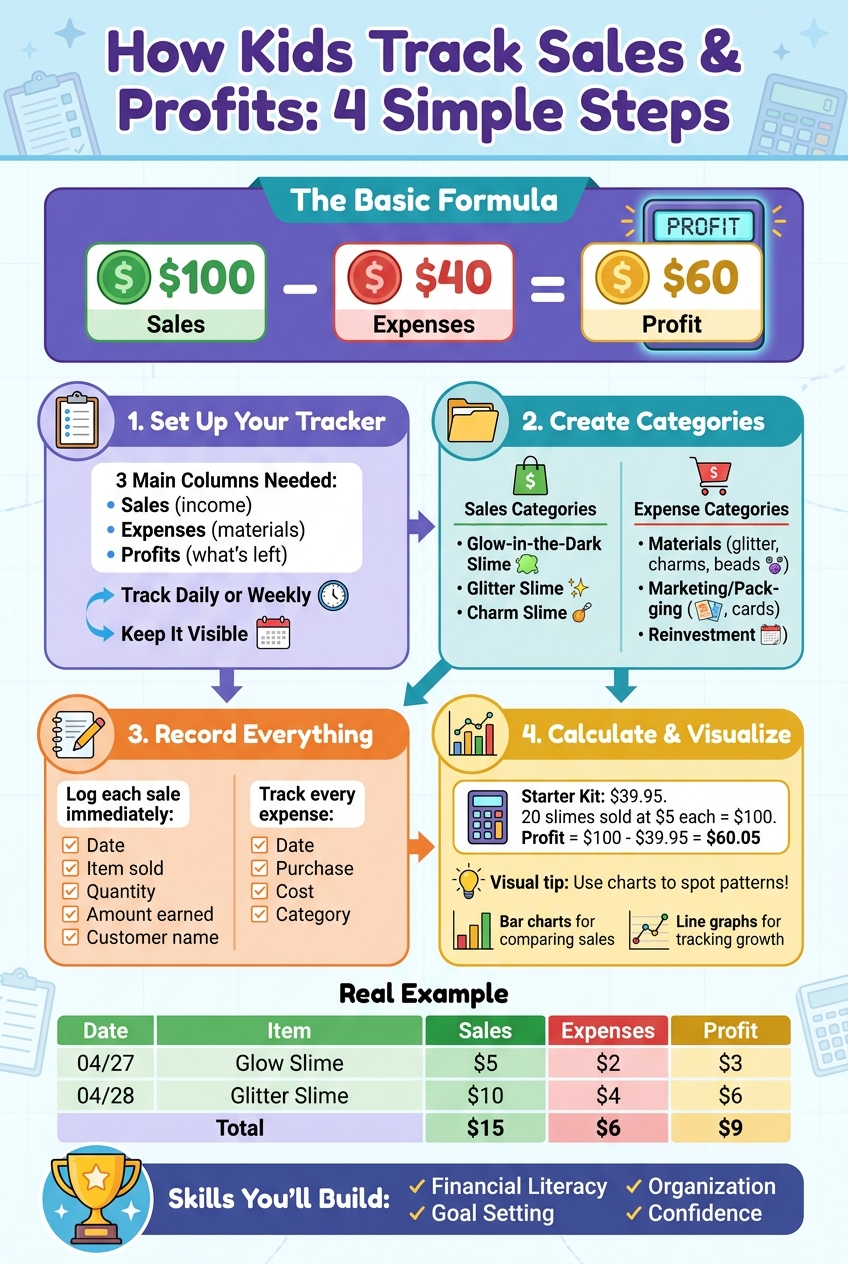
When kids start their first business, tracking sales and profits teaches them essential money management skills. By recording revenue, expenses, and profits, they learn how to manage costs and set goals. This often begins with brainstorming a business based on their interests. For example, if a child sells slime for $5 but spends $2 on materials, their profit is $3. Tools like sales trackers simplify this process, helping kids stay organized and make informed decisions about their business.
Key Takeaways:
- Sales Tracking Basics: Record income, expenses, and profits for every transaction.
- Benefits: Kids gain financial literacy, organizational skills, and confidence.
- Practical Example: Selling 20 slimes at $5 each equals $100 in sales. Subtracting $40 in costs leaves $60 in profit.
- Tools: Pre-made kits or simple spreadsheets can help kids track their progress.
Learning to track finances early helps kids build habits they can use throughout life.
How to Track Sales and Profits in Your Kids Business - 4 Step Guide
Excel Kids - Lemonade Stand! Keep track of expenses and profits. Chart, too!
sbb-itb-a46f019
Setting Up Your Sales Tracker
To get started with a sales tracker, you’ll need three main columns: Sales (income), Expenses (money spent on materials), and Profits (what’s left after expenses). If you're using the My Lil Startup Slime Business Kit, it already includes a built-in tracker, but understanding how to set it up yourself can help kids make the most of every entry.
Kids can organize their tracker with daily or weekly entries, depending on how often they sell. For busier times like weekend markets or local events, daily tracking works best. On the other hand, weekly tracking is ideal for those who sell less frequently. Choosing consistent "anchor points" for updates - like the end of each day or Sunday evenings - makes tracking feel more routine and manageable.
It’s also important to keep the tracker visible and easy to access. Placing it somewhere like the kitchen counter or a workspace serves as a reminder to update it regularly and encourages kids to take responsibility for their business.
Creating Sales and Expense Categories
Once the tracker is set up, the next step is to break down sales and expenses into specific categories. This makes it easier to see patterns and understand which products or strategies are working. For sales, kids can track different slime types separately - like "Glow-in-the-Dark", "Glitter Slime", or "Charm Slime." This way, they can figure out which ones are the most popular and decide what to focus on making more of.
On the expense side, grouping costs into categories simplifies tracking. For example:
- Materials: Includes glitter, charms, beads, and other supplies like glow powder.
- Marketing/Packaging: Covers items such as flyers, thank-you cards, and tablecloths.
Amanda, a parent of a young entrepreneur, shared her approach to managing her daughter's slime business:
We put back half of her sales to purchase more inventory.
Adding a "Reinvestment" category to the tracker can help kids adopt this strategy and plan for future growth.
Here’s an example of how a tracking entry might look:
| Date | Item/Category | Sales ($) | Expenses ($) | Profit ($) | Notes |
|---|---|---|---|---|---|
| 04/27 | Glow Slime | $5.00 | $2.00 | $3.00 | Sold to neighbor |
| 04/28 | Glitter Slime | $10.00 | $4.00 | $6.00 | Birthday party sale |
| Total | $15.00 | $6.00 | $9.00 |
For instance, selling 20 slimes at $5.00 each brings in $100.00 in sales. This helps kids set clear revenue goals and see if their business is covering its costs, like the initial kit purchase.
Personalizing Your Tracker
To make the tracker even more useful, adding personal touches can go a long way. While the columns handle the math, a "Notes" section can capture insights and lessons. Kids might jot down things like, "Customer asked for more glitter" or "Sold three at the school fair." These details can guide future decisions and improve their sales approach.
Some kids may find color-coding categories or using symbols helpful. For example, a star could mark best-sellers, while different colors might highlight sales from special events. These visual cues make it easier to review the tracker, especially for younger kids still learning to stay organized.
Setting personal milestones can also be a fun motivator. Kids could aim to sell their first 10 slimes or save up enough to buy more materials, marking these achievements in their tracker to celebrate progress.
Recording Daily Sales and Expenses
Keeping accurate records is the backbone of understanding profits - an essential part of running a successful business. Once your tracker is set up, the focus shifts to logging every transaction as it happens. For each sale, kids should note the date, the item sold, the quantity, and the total amount earned. For example, if two Glow-in-the-Dark Slimes are sold on April 27, 2026, the entry would include the date, "Glow-in-the-Dark Slime", the number "2", and the total of $10.00. Adding the customer's name, like "Neighbor Joe", can help identify repeat buyers and build a loyal customer base.
Documenting sales immediately is crucial. Delaying this step often leads to forgotten details and inaccuracies. During busy times, such as a weekend market or school fair, it’s easy to lose track of transactions. Keeping a small notebook or the sales tracker from the My Lil Startup kit nearby ensures every sale is recorded on the spot. Once this habit is established, it’s time to focus on documenting each sale consistently.
How to Record Each Sale
Consistency is the key to effective record-keeping. For every slime sold, kids should log the date, item, quantity, amount earned, and customer name (if applicable). Over time, this provides a clear picture of what’s selling well. For instance, if "Glitter Slime" consistently outpaces other items, that trend becomes undeniable. This kind of tracking moves beyond guesswork, offering solid evidence of what drives revenue.
If shorthand is used during a busy day, it’s important to fill in the full details later. This approach works just as well for a simple paper tracker as it does for an app or spreadsheet.
Once sales are recorded properly, the next step is to track expenses with the same level of care.
How to Track Your Expenses
Tracking expenses is just as important as recording sales. Every time money is spent - whether on glitter, charms, packaging materials, or promotional flyers - kids should note the date, the purchase, the cost, and the category it belongs to (e.g., "Materials" or "Marketing"). Keeping all receipts in one place makes it easier to verify numbers later.
Careful expense tracking is essential for calculating profits accurately. Remember, profit equals revenue minus costs. For example, if $4.00 is spent on materials to make a slime that sells for $5.00, the actual profit is $1.00 - not $5.00. Logging expenses right away helps avoid mistakes and provides a detailed view of where the money is going. Even small expenses, like tape or thank-you cards, can add up over time and impact profits if overlooked.
Calculating Your Profit
Once you've tracked your sales and expenses, it’s time to figure out your profit. The formula is straightforward: Total Sales − Total Expenses = Profit. In a slime business, Sales refers to all the money earned from customers, while Expenses cover the costs of the starter kit, supplies, and any marketing materials.
Profit is essentially what’s left after you’ve covered your costs. For example, if a young entrepreneur sells 20 slimes at $5.00 each, their total sales would be $100.00. However, if the Starter Kit cost $39.95, the profit isn’t $100.00 - it’s $60.05. That remaining amount represents the actual earnings after the initial investment is accounted for. To make this clearer, let’s look at a few examples.
Practice with Real Numbers
Imagine a child purchases the Starter Kit for $39.95 and successfully sells all 20 slimes for $5.00 each. Their calculation would look like this: $100.00 (total sales) − $39.95 (kit cost) = $60.05 (profit).
Now, consider someone using the Mogul Bundle, which provides enough materials to make 60 slimes. If they sell all 60 slimes at $5.00 each, their total sales would be $300.00. Subtracting the $99.95 cost of the bundle leaves them with a profit of $200.05. These examples highlight how different levels of investment can influence overall earnings and help young entrepreneurs better understand the link between spending and profit.
Why Profit Numbers Matter
Knowing your profit isn’t just about seeing how much you’ve earned - it’s a key factor in making smart business decisions. Profit figures help guide choices about saving, reinvesting, and planning for the future. Amanda, a parent and small business owner, shared her approach:
We put back half of her sales to purchase more inventory.
Profit numbers also highlight areas for improvement. If profits aren’t meeting expectations, kids can rethink their strategies - like adjusting prices or finding ways to cut unnecessary costs. This process not only helps the business grow but also teaches valuable money management skills that can be applied beyond the slime business.
Using Charts to See Your Progress
After crunching the numbers, charts can make it easier to understand what's really happening in your business. While numbers give you the data, charts bring it to life by highlighting trends and patterns. For instance, when kids use the sales tracker included in the My Lil Startup Slime Business Kit to create simple graphs, they can easily spot which days were the most profitable or which slime flavors were the top sellers.
Making Basic Graphs
Bar charts are a simple way to compare sales across categories. Start by drawing a horizontal line for your categories - this could be days of the week or slime types like Glitter, Glow, and Basic. Along the side, label dollar amounts from $0 up to your highest sale. Then, color in bars for each category to match the sales totals. For example, if Wednesday brought in $25.00, the bar for Wednesday should reach the $25.00 mark.
Line graphs work well for tracking changes over time. Place your weeks along the bottom (Week 1, Week 2, etc.) and label the side with profit amounts. Plot the profit for each week and connect the dots. For instance, if profits jumped from $15.00 in Week 1 to $35.00 in Week 4, but dipped to $18.00 in Week 3 due to extra spending on decorations, the overall upward trend still shows growth.
Spotting Patterns in Your Data
With your graphs ready, patterns start to emerge. A bar chart might reveal that Saturday sales hit $50.00, while weekday sales average around $10.00, showing weekends are your busiest times. Similarly, you could see which slime flavors are the most popular, helping you decide what to produce more of.
Expense trends are just as important. A line graph might show that ingredient costs spike to $12.00 every Friday for restocking. By buying supplies earlier in the week, you might lower that cost to $8.00. These visual takeaways can help you make smarter decisions about sales and expenses moving forward.
Conclusion: Building Skills That Last
Keeping track of sales and profits is the backbone of running a successful business. By organizing your sales tracker with clear categories and diligently recording every sale and expense, you’re laying the groundwork for understanding your business’s true performance. Calculating profit - by subtracting total expenses from total sales - gives you a clear picture of your earnings, while charts and graphs transform those numbers into patterns that help you make smarter, more informed decisions. These habits not only provide clarity about how your business is doing but also prepare you to tackle future challenges with confidence.
The skills you’re building now go beyond just your slime business. Developing habits like budgeting, keeping accurate records, and analyzing data sets you up for success in any future venture, whether it’s running an online store, managing a lemonade stand, or navigating your first job. Research shows that these habits not only improve financial literacy but also strengthen overall academic skills.
The sales tracker included in the My Lil Startup Slime Business Kit is a great tool to help you practice these skills right away. For example, noticing that Saturday sales hit $50.00 while weekday sales average $10.00 can help you decide when to stock up on inventory or set up your table. Watching your profit grow from $20.00 in Week 1 to $100.00 in Week 4 on a line graph demonstrates your progress as an entrepreneur. These insights make it easier to apply what you’ve learned and make smarter decisions for your business.
Start tracking today and build the confidence to make informed decisions. Each sale and expense you log strengthens your entrepreneurial mindset and turns your ideas into real success.
FAQs
What should I do if I forget to log a sale?
If you miss logging a sale, make sure to record it as soon as it comes to mind. For physical trackers, jot down the date, amount, and any customer details you can recall. If you're using a digital app, update the information right away. Keeping your records consistent helps ensure your earnings and expenses stay accurate and well-organized.
How do I track the cost of the starter kit in my profits?
When calculating your profits, make sure to include the total cost of the starter kit as an expense. To find your net profit, subtract this cost from your total sales revenue.
For instance, if you made $50 in sales and your starter kit cost $20, your net profit would be $30.
Use the sales tracker included in the kit to log all your sales and expenses. This will help you keep an accurate record of your earnings and costs.
How do I know if I should raise my prices or cut costs?
If your products are flying off the shelves, sales are strong, and your costs are steady or even dropping, it might be time to increase prices. On the other hand, if sales are sluggish or your costs have risen sharply, cutting expenses could be the smarter move.
To make an informed decision, keep an eye on your numbers. Use the sales tracker included in the kit to stay on top of your earnings and expenses. Additionally, reviewing your profit and loss statement can offer valuable insights into whether pricing adjustments or cost-saving measures are necessary.