

If you're selling or creating business kits for kids aged 12 and under in the U.S., CPSC certification is mandatory. This ensures the kits meet federal safety standards, protecting children from hazards like lead, harmful chemicals, and choking risks. Here's what you need to know:
- Children's Product Certificate (CPC): You must issue this document based on test results from a CPSC-approved lab.
- What Needs Testing: Every component in the kit - no matter how ordinary (like paper clips or rubber bands) - must comply with children's safety standards.
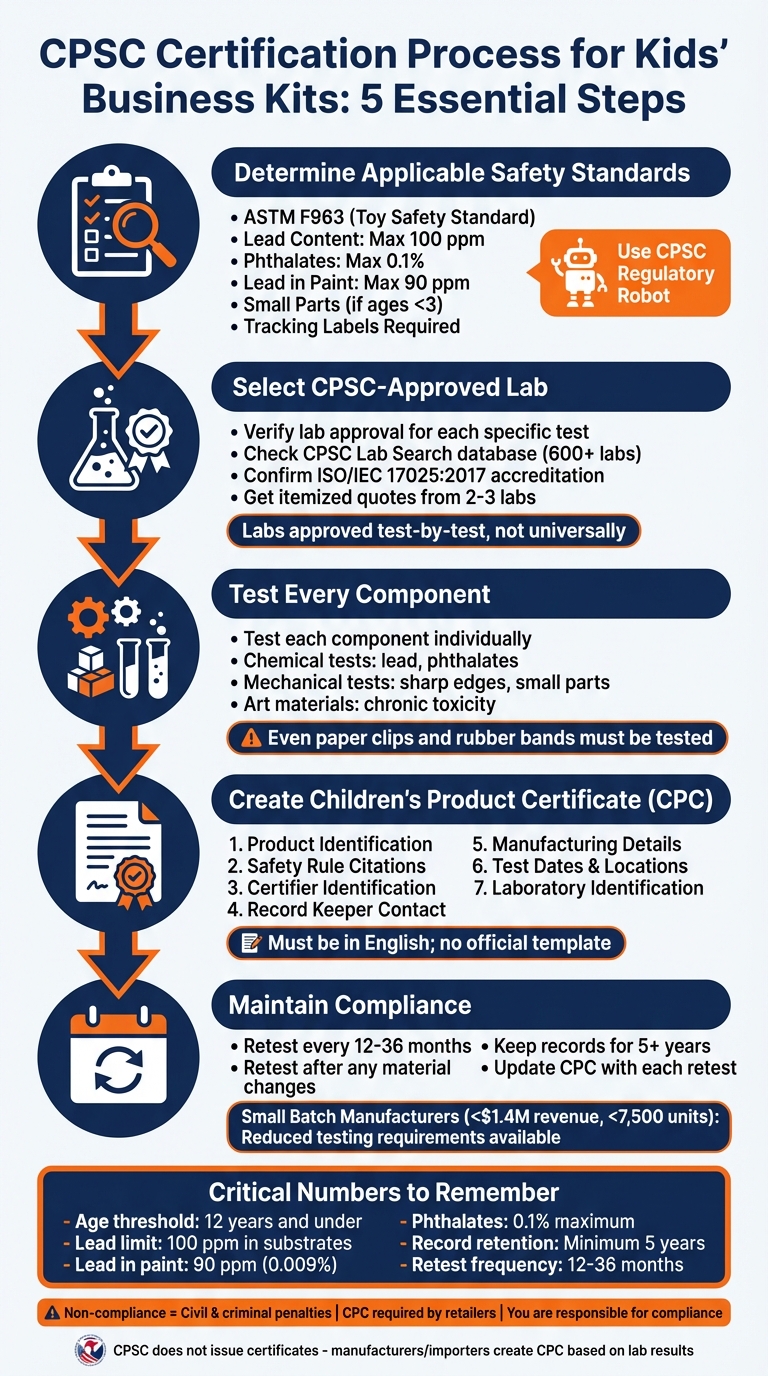
- Key Safety Standards: Includes ASTM F963 (toy safety), lead content limits (100 ppm), phthalate restrictions (0.1%), and more.
- Tracking Labels: Required on both the product and its packaging, showing manufacturing details.
- Retesting Requirements: Products must be retested every 12-36 months or after any material changes.
Failing to comply can result in hefty fines or legal penalties. Certification isn't just a legal requirement - it ensures your product is safe and builds trust with consumers. Ready to dive into the details? Let’s break it down step by step.
CPSC Certification Process for Children's Products: 5-Step Compliance Guide
Webinar: CPSIA: Get a Children’s Product Certificate and sell in the US
sbb-itb-a46f019
What Is CPSC Certification?
CPSC certification involves a formal written document called a Children's Product Certificate (CPC). This certificate is issued by manufacturers or importers to confirm that their product complies with all relevant federal safety regulations for children's products. Importantly, the CPSC itself does not issue this certificate. Instead, you create it based on successful test results from a third-party laboratory that is approved by the CPSC. As the CPSC clarifies:
The passing test report from a CPSC-accepted, third party laboratory serves as the foundation for the creation of the CPC, but it is not the CPC itself.
The CPC is essentially a declaration that your product meets federal safety standards. It ensures that every component in a product complies with these regulations. The certificate must include seven key details: product identification, applicable safety rules, contact information, record keeper details, manufacturing and testing dates and locations, and laboratory information. This document is mandatory for product shipments to distributors and retailers, and you are legally required to keep these records for at least five years.
What Counts as a Children's Product
According to the CPSC, a children's product is any consumer product designed or intended primarily for children 12 years of age or younger. The determination is based on four factors: manufacturer statements (such as labels or marketing materials), packaging and advertising imagery, consumer perception, and the agency's Age Determination Guidelines.
For business kits aimed at kids in this age group, every single component inside - even seemingly ordinary items like paper clips, rubber bands, or thank-you cards - must meet children's safety standards. For example, a slime business kit containing pre-made slimes, decorations, marketing flyers, and sales trackers would require each item to be tested and certified. General-use items cannot be assumed to be safe for children; they must undergo separate testing and certification.
Why CPSC Certification Matters
Understanding what qualifies as a children's product highlights the importance of thorough certification. Certification is critical because it protects children from hidden dangers. Testing screens for risks such as chemical exposure (e.g., lead content limited to 100 ppm and phthalates capped at 0.1%), choking hazards from small parts, mechanical risks like sharp edges, and long-term health concerns from art materials. For parents buying entrepreneurship kits, the CPC serves as proof that the product has been rigorously tested by a third party before reaching their children.
From a business standpoint, certification is not optional. Under Section 14 of the Consumer Product Safety Act, failing to provide a certificate - or issuing a false one - can lead to both civil and criminal penalties. Additionally, many online retailers and platforms require a CPC before allowing products to be sold. This not only ensures legal compliance but also builds trust with customers and safeguards against liability in case of product recalls. Without proper certification, selling children's products legally in the U.S. is impossible.
CPSC Certification Requirements for Kids' Business Kits
Safety Rules and Regulations That Apply
Products like our kids' slime business kit are subject to several federal safety standards, all of which must be followed. The main standard is ASTM F963, a mandatory toy safety regulation outlined in 16 CFR part 1250. This standard addresses material quality, toxicology, accessible edges and points, and other mechanical safety concerns. Additionally, every component of the kit must comply with lead content limits (no more than 100 ppm in substrates, as per 15 U.S.C. § 1278a) and lead in paint restrictions (capped at 90 ppm or 0.009 percent under 16 CFR part 1303).
For phthalates, restrictions under 16 CFR part 1307 limit specific types to a maximum of 0.1 percent in children’s toys. If the kit is intended for children under 3 years old, it must also comply with small parts regulations (16 CFR part 1501), which aim to prevent choking hazards. Kits designed for ages 3 to 6 require specific small parts labeling under ASTM F963 section 4.6. If art supplies like crayons, paint, or clay are included, they must be tested for chronic toxicity and labeled according to the Labeling of Hazardous Art Materials Act (16 CFR § 1500.14(b)(5)).
Even items typically considered general use, such as rubber bands or paper clips, must meet children's product safety standards. Additionally, all kids’ products must include permanent tracking labels on both the product and its packaging (15 U.S.C. § 2063(a)(8)). These labels should display the manufacturer’s name, the location and date of manufacture, and a batch or run number. To determine the exact safety rules for your kit, the CPSC’s Regulatory Robot tool is a helpful resource.
Once your kit complies with these standards, you’ll need to prepare the required documentation for your CPC.
Children's Product Certificate (CPC) Requirements
The CPC is a formal document that confirms your product has passed third-party testing and complies with all federal safety standards. It must include seven essential elements, presented in English. While there’s no official template, the information must be clear and complete.
Here’s a breakdown of the required elements for the CPC:
| CPC Element | Required Information |
|---|---|
| 1. Product Identification | A detailed description, including model name/number and any color variations |
| 2. Safety Rule Citations | A list of all applicable CPSC safety rules (e.g., 16 CFR part 1303, ASTM F963-17) |
| 3. Certifier Identification | Name, full address, and phone number of the U.S. manufacturer or importer |
| 4. Record Keeper Contact | Contact details (name, address, email, phone) for the person maintaining test records |
| 5. Manufacturing Details | Manufacturing date and location (city, state, and country of final assembly) |
| 6. Test Dates & Locations | Date(s) and location(s) of the testing |
| 7. Laboratory Identification | Name, address, and phone number of the CPSC-approved third-party lab(s) used |
You are required to keep the CPC and all related test records for at least five years. The certificate must also accompany shipments sent to distributors and retailers.
The Third-Party Testing Process
How to Choose a CPSC-Approved Testing Lab
The Consumer Product Safety Commission (CPSC) approves testing labs on a test-by-test basis. This means a lab accredited for lead testing might not be approved for phthalates or ASTM F963 compliance. To ensure you're working with the right lab, verify that it is accredited for every specific test your kit requires. Start by using the CPSC Lab Search database at https://www.cpsc.gov/labsearch, which lists over 600 accepted laboratories worldwide that perform various children's product safety tests.
Before reaching out to any lab, use the CPSC Regulatory Robot tool to determine which safety regulations apply to your kit components. When requesting quotes, ask for itemized estimates from two to three labs. Make sure they distinguish between federally required tests and those that are recommended by specific retailers. To save on costs, inquire about composite testing (which groups similar materials together) or XRF lead screening. If a lab proposes additional tests, always request the specific legal reference (e.g., 16 CFR Part 1307) to avoid unnecessary expenses.
It's also essential to confirm that the lab is independently accredited to ISO/IEC 17025:2017. This accreditation ensures the lab meets technical and management standards, reducing the risk of undue influence on results. Additionally, labs must provide an estimate of their measurement uncertainty. For example, if a lead test result is 90 ppm and the legal limit is 100 ppm, the lab's uncertainty range might make it impossible to certify the product.
Once you've chosen a qualified lab, proceed to test each kit component individually.
Testing Individual Kit Components
Every component in a kit intended for children aged 12 or younger must meet federal safety standards. For a slime business kit, this includes testing the slime itself, plastic containers, decorations, marketing materials, and even small items like rubber bands or paper clips, which are common in screen-free toys and kits. While mechanical hazards should be tested on the fully assembled kit, chemical testing can be performed on individual components.
| Component Type | Common Testing Requirements | Relevant Regulation |
|---|---|---|
| Slime / Liquids | Phthalates, Total Lead Content | 16 CFR 1307, 15 U.S.C. § 1278a |
| Plastic Charms/Beads | Lead in Substrate, Phthalates | 15 U.S.C. § 1278a, 16 CFR 1307 |
| Small Parts | Small Parts Ban (for ages <3) | 16 CFR 1501 |
| Painted Containers | Lead in Paint/Surface Coatings | 16 CFR 1303 |
| Finished Kit | Toy Safety Standard | ASTM F963 (16 CFR 1250) |
If your supplier provides component testing results, take extra steps to verify their validity. This might include contacting the lab directly or conducting spot-checks on the results. As the CPSC Small Business Guide emphasizes:
You, as the manufacturer or importer, are ultimately responsible for the compliance of your product with federal safety standards and testing requirements.
Creating the Children's Product Certificate
Once you’ve received passing test reports for all components, you can create the Children's Product Certificate (CPC). These test reports are the basis for the CPC but do not serve as the certificate itself. As the CPSC explains:
The passing test report from a CPSC-accepted, third party laboratory serves as the foundation for the creation of the CPC, but it is not the CPC itself. You must issue the CPC as a separate, standalone document.
The CPC must be written in English and include seven required elements, though there isn’t an official government template. When describing the product, include specific variations - such as different colors or scents of slime - if they fall under the same testing. Use the exact Lab ID and name listed in the CPSC database for accuracy.
Be sure to retain copies of the CPC and supporting documents in line with regulatory timelines. The certificate should accompany shipments sent to distributors and retailers. For kits manufactured overseas, the U.S. importer is responsible for issuing the CPC; relying solely on the foreign manufacturer’s certificate is not permitted.
How to Maintain CPSC Compliance
Once you've achieved compliance through testing and certification, the next step is ensuring it stays intact. This involves sticking to specific retesting schedules and keeping detailed records.
When to Retest Your Products
Compliance certification isn’t a one-and-done process; it requires ongoing attention. According to CPSC guidelines, products need to be retested every 12 months under a written testing plan. This interval can extend to 24 months if production testing is implemented or up to 36 months when using an ISO/IEC 17025-accredited lab.
Retesting is also mandatory whenever there’s a material change in the product's design, manufacturing process, or component sourcing. The CPSC defines a material change as:
A material change is a change that the firm makes to their product's design, to the manufacturing process, or to the source of component parts for the product, which could affect the product's ability to comply with the applicable requirements.
For example, switching to a new supplier for slime, altering the type of plastic used in containers, or changing paint brands all qualify as material changes. Each change requires retesting the impacted components and issuing a new Children's Product Certificate. For short-run products (produced for less than a year), initial certification and retesting are only required when such changes occur.
Keeping Records and Documentation
Proper record-keeping is essential for maintaining compliance. You’re required to retain all compliance-related documents - such as CPCs, test reports, and testing plans - for at least five years. Electronic storage is acceptable as long as the records are secure and their integrity is preserved.
Your records should also include documentation of undue influence training for any staff involved in testing. This training ensures that no one pressures labs to alter test results. If you rely on component testing from suppliers, confirm that they maintain accurate testing plans and records. The CPSC underscores this point:
Firms must have a high degree of assurance that the children's products it manufactured after the initial test and issuance of a CPC... continue to comply with the applicable children's product safety regulations.
Keeping your documentation up-to-date not only ensures compliance but also simplifies the certification process during audits.
Options for Small Batch Manufacturers
For smaller businesses, the CPSC offers simplified requirements to ease the testing process while still prioritizing safety.
If your annual revenue is $1,436,864 or less and you produce fewer than 7,500 units, you may qualify as a Small Batch Manufacturer (SBM). This status provides relief from Group B testing requirements (such as total lead content, phthalates, and ASTM F963). However, Group A tests - like lead in paint, small parts testing, and durable infant product requirements - must still be conducted in CPSC-approved labs.
To maintain SBM status, you need to register annually on SaferProducts.gov and recertify every December. Be sure to include your CPSC-issued registration number in Section 7 of your Children's Product Certificate. Without this annual registration, you won’t qualify for testing relief in the following year.
Conclusion
CPSC certification plays a key role in safeguarding children and fostering trust with parents and retailers. Products intended for kids aged 12 and under must meet federal safety standards, undergo testing at a CPSC-approved lab, and include a Children's Product Certificate (CPC). This requirement applies to every component of the product once it’s packaged as a kit for children. Beyond reducing legal risks, this certification helps establish trust with consumers and retail partners.
Take, for example, a product like My Lil Startup's Slime Business Kit. Certification ensures that chemicals such as borax stay within safe limits, small parts don’t pose choking hazards, and materials are free from harmful levels of lead and phthalates. Each component, from materials to chemicals, must meet strict safety standards, forming the foundation of responsible product development.
When dealing with kids' business kits, always verify the presence of a valid CPC. Manufacturers and importers are required to retain these certificates and related test results for at least five years. As noted by Retro Slime Company:
Non-compliance can lead to heavy fines and imprisonment.
– Retro Slime Company
While the certification process may seem rigorous, it ensures that every kit is thoroughly evaluated for safety and meets legal requirements. Whether you’re creating or purchasing these kits, CPSC certification provides peace of mind that the product is safe and complies with all regulations.
FAQs
Do I need a CPC if my kit is labeled for ages 13+?
No, a Children's Product Certificate (CPC) is not necessary if your kit is labeled for ages 13 and up. CPCs are specifically required for products designed for children under the age of 13, as these items must meet federal safety regulations.
Can I use my supplier’s test reports instead of testing myself?
Products cannot rely solely on a supplier's test reports to confirm compliance. Instead, they must undergo testing at a CPSC-accepted third-party laboratory. The responsibility for certifying compliance falls on the manufacturer or importer, using the results from these tests. This process ensures that children's products meet all required safety standards.
What changes require retesting and reissuing a CPC?
If there are any changes to your product's design, manufacturing process, or the source of its component parts that could influence compliance, you must retest the product and issue a new Children's Product Certificate (CPC). Such changes might affect whether the product continues to meet the required safety standards.