

Starting a slime business can teach kids how to make money as a kid while having fun. Here’s what they need to know:
- Budgeting Basics: Understand income, expenses, and profit. For example, if a slime jar costs $1 to make and sells for $3, the profit is $2.
- Startup Costs: Initial expenses include glue, containers, and decorations. Kits like My Lil Startup simplify this with all essentials bundled, starting at $39.95.
- Tracking Finances: Use tools like sales trackers or notebooks to log every sale and expense. Staying organized ensures the business stays profitable.
- Pricing for Profit: Calculate the cost per slime (e.g., $2 from the Starter Kit) and set a selling price (e.g., $5–$10) to cover costs and earn profit.
- Saving for Growth: Set aside part of the earnings (e.g., 20–50%) for restocking or unexpected costs, ensuring the business can keep running.
HOW TO START YOUR OWN SUCCESSFUL SLIME SHOP!! PART 2
Understanding Startup Costs
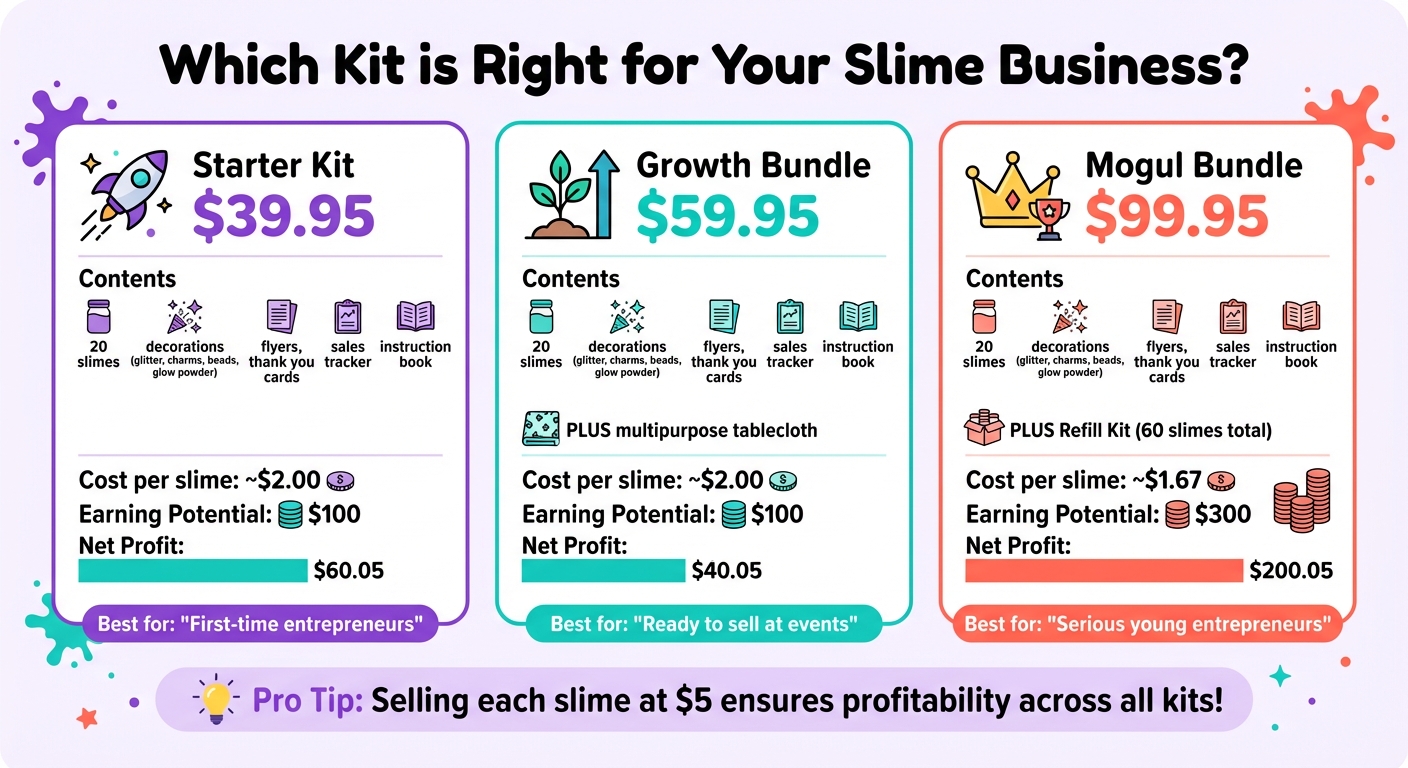
My Lil Startup Kit Comparison: Costs, Contents, and Profit Potential
Before making your first sale, it's crucial to understand your startup costs - those initial expenses required to launch your business. For a traditional slime business, these expenses can stack up quickly. Professional slime entrepreneurs often spend anywhere from $500 to $2,000 on bulk materials, packaging, and product testing.
Key costs include glue (priced at $20–$23 per gallon), containers, activators, scents, mixing bowls, digital scales, and decorations. You'll also need safety gear like nitrile gloves and aprons, along with tools such as silicone spatulas and squeeze bottles. For those aiming for a professional setup, stand mixers (typically $150–$200 for used models) are a common investment, and safety testing alone can cost around $1,000. Considering these expenses, complete kits can be a practical starting point for young entrepreneurs.
How My Lil Startup Kits Simplify Startup Costs
My Lil Startup kits offer a convenient "business in a box" solution, bundling all the essential supplies you need to get started. Each kit includes 20 pre-made slimes, rainbow glitter, charms, beads, glow-in-the-dark powder, marketing flyers, thank you cards, and a sales tracker.
| Bundle Name | Price | What's Included | Earning Potential |
|---|---|---|---|
| Starter Kit | $39.95 | 20 slimes, decorations, flyers, cards, sales tracker, instruction book | $100 |
| Growth Bundle | $59.95 | Everything in Starter Kit + Multipurpose Tablecloth | $100 |
| Mogul Bundle | $99.95 | Everything in Starter Kit + Tablecloth + Refill Kit (60 slimes total) | $300 |
These kits are designed to pay for themselves. For instance, if you sell each of the 20 slimes in the Starter Kit for $5, you’ll make $100. Subtract the $39.95 investment, and you’re left with $60.05 in profit. This clear pricing strategy helps ensure your slime business is profitable from the start.
Amanda, a parent and small business owner, shared her thoughts: "The kit came with everything you would need to start your business and more! ... Within our first week she had sold every slime".
This low-risk approach allows kids to explore the market without committing to expensive equipment or supplies they might not actually need.
Calculating Additional Startup Costs
While the kits cover most essentials, some kids might want to personalize their slime with extra decorations. For example, if you spend $5 on a pack of unicorn charms that can decorate 10 jars, that adds $0.50 per slime. Be sure to track these additional expenses when setting your prices to ensure you're still making a profit. Keeping receipts or taking photos of your purchases can help you stay organized and accurately calculate your costs.
Tracking Income and Expenses
When you start selling slime, keeping track of every sale and expense becomes a must. Without proper records, it’s hard to tell if you’re making a profit or just breaking even. Once you’ve figured out your startup costs, the next step is to track every dollar earned and spent. Below, we’ll explore how a physical sales tracker and simple manual methods can help you stay on top of your business finances.
Using Sales Trackers for Record-Keeping
Every My Lil Startup kit comes with a Sales Tracker to help kids log their financial activity. This tracker allows you to record important details like buyer information, sale amounts, and any extra expenses. The kit also includes a Success Instruction Book, which walks you through managing money step-by-step, including tips like counting change correctly.
Daily record-keeping is essential for understanding your cash flow. For instance, the kit features a Top Secret Envelope that you’re only allowed to open after reaching $50 in sales. You’ll only know when you hit that milestone if you’re keeping track of every transaction.
Amanda, a parent and small business owner, shared: "We put back half of her sales to purchase more inventory. The kit... teaches her how to manage money, socialize with new people, [and] work for what she wants".
Whether you stick with the physical tracker or move to a digital option, staying organized with your records is crucial for managing your earnings.
Manual vs. Digital Tracking Options
If the physical tracker feels a bit old-school, there are plenty of other ways to keep your records in check. A simple notebook is an easy alternative - just create two columns labeled "Money In" and "Money Out", and jot down each transaction along with the date and amount.
The physical Sales Tracker included in the kit is a great way to learn without relying on screens. As your business grows, you might decide to transition to digital tools like spreadsheets or kid-friendly budgeting apps. However, starting with manual tracking helps build strong financial habits. The most important thing is consistency - whether you use the provided tracker, a notebook, or a digital tool, make it a daily routine to record your finances at the end of each selling day.
Pricing Slime for Profit
Calculating Cost of Goods Sold (COGS)
To figure out the cost of making each slime (COGS), divide the total cost of your kit by the number of slimes it produces. For example, the My Lil Startup Starter Kit costs $39.95 and makes 20 slimes, which breaks down to about $2.00 per slime. This price includes everything - slime, containers, glitter, charms, beads, and even glow-in-the-dark powder.
As your business grows, buying supplies in bulk can help lower the cost per slime. Take the Refill Kit, for instance. It costs $59.95 and produces 40 slimes, reducing the cost to around $1.50 per slime - a 25% savings compared to the Starter Kit.
| Kit Type | Total Cost | Number of Slimes | Cost Per Slime (COGS) | Potential Revenue (at $5/each) |
|---|---|---|---|---|
| Starter Kit | $39.95 | 20 | ~$2.00 | $100 |
| Refill Kit | $59.95 | 40 | ~$1.50 | $200 |
| Mogul Bundle | $99.95 | 60 | ~$1.67 | $300 |
Once you know your cost per slime, it’s time to set a price that covers expenses and ensures a profit.
Setting a Competitive Price
With your COGS in hand, you can use a markup strategy to set your selling price. A good rule of thumb is to multiply your COGS by 3 or 4 to ensure profitability. For instance, if your slime costs $2.00 to make, selling it for around $6.00 per jar provides a healthy margin.
You can adjust your price based on added features, like extra charms, unique textures, or glow-in-the-dark elements. Pricing between $5.00 and $10.00 is a reasonable range, depending on your product's appeal. Testing different price points at local parks, community events, or even neighborhood sales can help you identify what works best for your market.
Amanda, a parent and small business owner, shared: "We put back half of her sales to purchase more inventory."
This approach not only helps you refine your pricing strategy but also ensures your slime business stays profitable and sustainable.
Building a Savings Reserve and Managing Unexpected Costs
Setting Aside a Savings Reserve
When those first sales start rolling in, it can be tempting to spend every dollar right away. But smart young entrepreneurs know the importance of saving a portion of their earnings to keep their business running smoothly. For instance, if you make a $5 sale, putting aside 20% - or $1 - can help you build a reserve for future expenses like a Refill Kit ($59.95) or extra decorations.
Some families take it a step further with the "Half-Back" Strategy, saving 50% of sales to accelerate growth. This method worked wonders for one young entrepreneur, who managed to move from her initial kit to ongoing operations in just her first week. To stay on top of your savings, use the Sales Tracker included in your kit. You can store the money in a jar or the "Top Secret Envelope" to keep it safe and avoid unnecessary spending.
This savings reserve plays a crucial role in covering both fixed and variable costs, ensuring you’re always prepared for restocking and other expenses.
Understanding Fixed and Variable Costs
Getting a clear picture of your fixed and variable costs can help you make smarter budgeting decisions. Fixed costs are one-time purchases, like your initial kit or a tablecloth, while variable costs fluctuate depending on how much slime you make - think additional decorations or a Refill Kit.
| Cost Type | Starter Kit | Growth Bundle | Mogul Bundle | Example |
|---|---|---|---|---|
| Fixed | Kit purchase ($39.95) | Kit + tablecloth ($59.95) | Kit + tablecloth + refills ($99.99) | One-time investment to launch |
| Variable | Additional decorations | Refill Kit ($59.95) | Extra glitter, charms, beads | Costs that recur as you produce more |
Understanding these costs helps you plan your savings and restocking strategy. Your reserve fund should focus on covering the cost of your next Refill Kit first, so you never run out of inventory and can keep your business running smoothly.
Conclusion and Key Takeaways
Starting a slime business is more than just a fun project - it’s a hands-on lesson in budgeting and entrepreneurship. By understanding startup costs, tracking expenses, pricing for profit, and setting aside savings, young entrepreneurs can develop practical money management skills that will serve them well beyond their first venture.
With My Lil Startup kits, everything you need is bundled into one convenient package. This eliminates the guesswork and avoids the extra $150–$300 that trial-and-error supply shopping can cost. Instead of worrying about what to buy, kids can focus on creating, selling, and learning.
The most successful slime makers keep a close eye on their finances. They track every dollar spent and earned, set prices that ensure profit, and save a portion of their earnings. This habit of saving helps cover fixed costs, like the initial kit, and variable expenses, such as new decorations or supplies.
Budgeting isn’t just about crunching numbers - it builds confidence. Watching their savings grow from $50 to $100 and beyond teaches kids the value of planning and managing both fixed and variable costs. It’s a powerful way to show how smart decisions lead to tangible results.
FAQs
What expenses should I track besides supplies?
Tracking costs beyond supplies is essential for a well-rounded budget. Make sure to account for marketing, sales, and operational expenses. These can include:
- Advertising: Costs for online ads, print media, or other promotional campaigns.
- Promotional materials: Items like flyers, business cards, or branded merchandise.
- Event fees: Expenses for trade shows, fairs, or networking events.
- Transaction fees: Charges from payment processors or financial institutions.
- Workspace setup: Furniture, equipment, or decorations for your business space.
- Safety equipment: Tools or gear required to maintain a safe work environment.
By keeping tabs on these areas, you'll have a clearer picture of your spending, helping you stay within budget and boost profitability.
How do I price slime if I add extra charms?
When setting a price for slime that includes extra charms, you need to account for the added costs while also recognizing the boost in appeal these charms bring. Typically, slime sells for $3 to $5 per container, but the inclusion of charms can push the price toward the upper end of this range. Make sure your pricing not only covers all expenses - charms included - but also leaves room for a profit. For instance, if the charms noticeably increase the product's attractiveness, pricing it between $4 and $5 makes sense.
How much money should I save for restocks?
To keep up with restocks, set aside enough money for essential supplies like slime ingredients and decorations. If you're running a small-scale slime business, you’ll usually need around $50–$100 for regular restocks. However, larger operations might require a bigger budget, depending on your sales volume and inventory demands. Be sure to adjust your savings based on how frequently you restock and the size of your business.