

Want to help your kids think like entrepreneurs? Teaching business problem-solving early can build confidence, decision-making skills, and resilience. Here's a quick guide to 10 strategies that make learning fun and practical for kids:
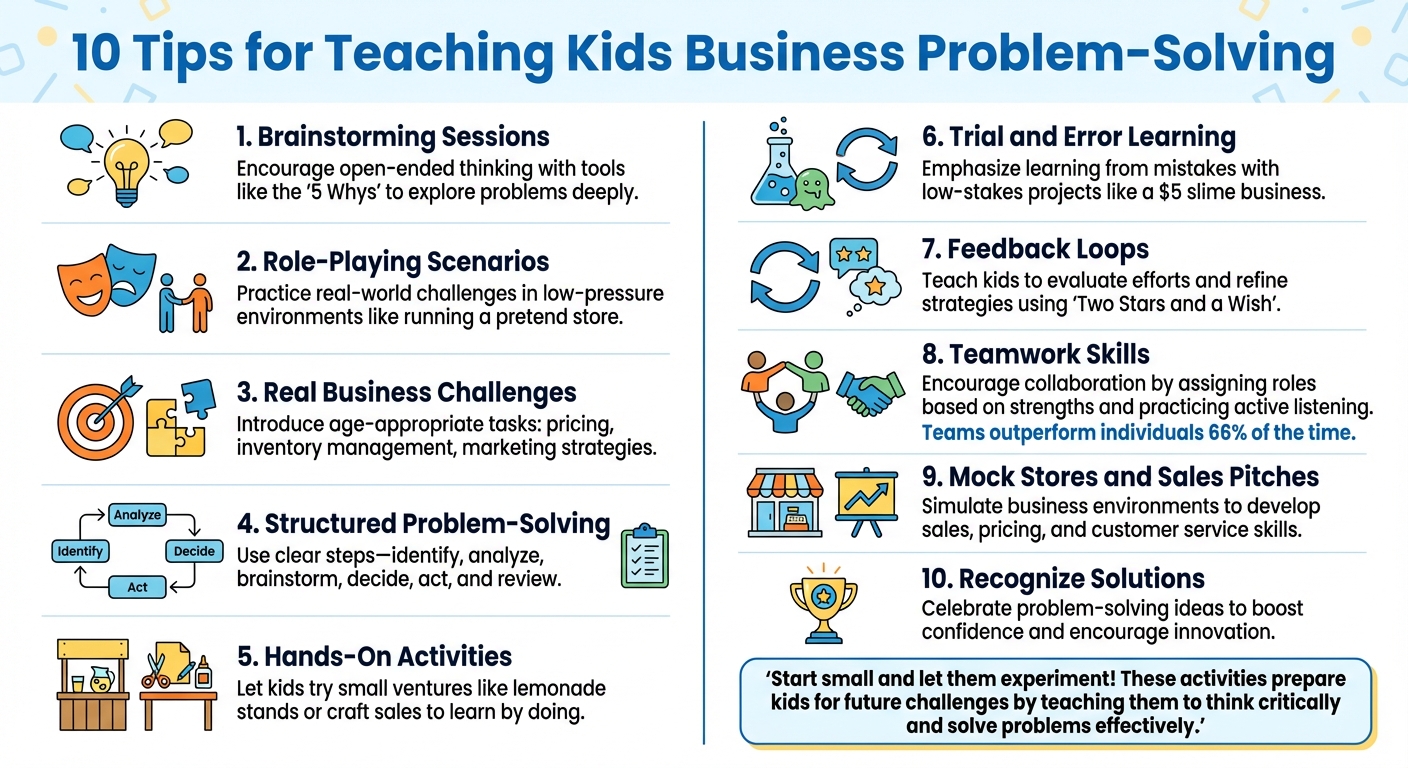
- Brainstorming Sessions: Encourage open-ended thinking with tools like the "5 Whys" to explore problems deeply.
- Role-Playing Scenarios: Practice real-world challenges in a low-pressure environment, like running a pretend store or solving customer issues.
- Real Business Challenges: Introduce age-appropriate tasks, such as pricing, managing inventory, or creating marketing strategies.
- Structured Problem-Solving: Use clear steps - identify, analyze, brainstorm, decide, act, and review - to tackle issues effectively.
- Hands-On Activities: Let kids try small ventures like lemonade stands or craft sales to learn by doing.
- Trial and Error Learning: Emphasize learning from mistakes with low-stakes projects like a $5 slime business.
- Feedback Loops: Teach kids to evaluate their efforts and refine strategies using methods like "Two Stars and a Wish."
- Teamwork Skills: Encourage collaboration by assigning roles based on strengths and practicing active listening.
- Mock Stores and Sales Pitches: Simulate business environments to develop sales, pricing, and customer service skills.
- Recognize Solutions: Celebrate their problem-solving ideas to boost confidence and encourage innovation.
Start small and let them experiment! Kits like the My Lil Startup Slime Business Kit provide tools to make learning both engaging and practical. These activities prepare kids for future challenges by teaching them to think critically and solve problems effectively.
10 Tips for Teaching Kids Business Problem-Solving Skills
Two Hands-on Activities to Help Kids Practice Problem Solving | Calm and Connected Episode 129
1. Start with Brainstorming Sessions
Brainstorming is the first step toward solving problems creatively. Teaching kids to come up with multiple ideas before taking action helps them develop "divergent thinking."
To make brainstorming effective, create a space where every idea is welcome - no matter how unusual it may seem. Set some ground rules: write down every suggestion, avoid criticism, and make sure everyone gets involved.
"Brainstorming business ideas can be fun and empowering when approached the right way" – JD Ribali, Biz Kidz USA
A great tool to try is the "5 Whys" method. For example, if sales are slow, ask "Why?" repeatedly to dig deeper and uncover the real issue.
Keep sessions short - 30 minutes or less - and make them interactive by using visual aids like markers or Post-it notes. If you're working on ideas for the My Lil Startup Slime Business Kit, brainstorm new slime flavors, pricing strategies, or creative ways to attract customers for a neighborhood stand.
To stay organized, assign roles like recorder, timekeeper, and facilitator. This structure ensures the session runs smoothly and sets the stage for the more hands-on activities to follow.
2. Practice with Role-Playing Scenarios
Once you’ve brainstormed ideas, role-playing helps bring them to life. This approach takes abstract business concepts and turns them into hands-on exercises, giving kids a chance to test ideas in a practical way. By simulating real-world challenges in a low-pressure environment, children can practice decision-making, resource management, and problem-solving without any real stakes.
Start with scenarios suited to your child’s age and skill level. For younger kids (ages 5–7), a simple setup like a pretend store can teach them how to count change and greet customers. Older kids (ages 12–14) can tackle more advanced challenges, like calculating profit margins or handling a scheduling conflict for a pretend pet-sitting business. These activities build a foundation for more complex role-playing exercises as they grow.
One idea to try is the "Struggling Stand" scenario. Imagine a lemonade stand or slime business with low customer turnout. Your child could brainstorm and role-play solutions - maybe they create better signage, offer a promotion, or relocate to a busier spot. If you’re using the My Lil Startup Slime Business Kit, you might simulate customer complaints, like a product leak, to teach professional problem-solving. This helps kids learn how to handle issues calmly and offer solutions that keep customers happy.
To make it feel more realistic, incorporate props like play money, receipt pads, or homemade business cards. You can even recruit family members to play different types of customers, showing how tone and attitude can affect interactions. These small touches make the experience engaging and memorable.
3. Present Real Business Challenges
Once role-playing has helped build confidence, it’s time to introduce actual business problems. Tackling real challenges helps kids understand that obstacles are a natural part of entrepreneurship - and that they can be solved with the right strategies. This transition from pretend scenarios to real-world issues is a vital step in hands-on learning for young entrepreneurs.
Start with challenges that match their age and skill level. For younger kids (ages 6–9), focus on simple tasks like counting change correctly or creating eye-catching signs. Tweens (ages 10–12) can handle more complex problems, such as setting prices, keeping basic financial records, and interacting with customers. Teens can dive even deeper, managing inventory, calculating profit margins, and learning about taxes. For example, minors earning over $400 in self-employment income may need to file a tax return. These activities build on earlier role-playing exercises and introduce real business decision-making step by step.
"The only tried and true way to learn to manage money is to manage money." – PenFed Credit Union
Start with basic financial concepts, like understanding the difference between revenue and profit. A simple "cost + markup" formula works well: calculate the cost of materials and add a 25–50% markup. For instance, if it costs $0.25 to make a cup of lemonade, selling it for $0.50 to $1.00 covers the cost and generates profit. You can also teach them about breaking even by dividing total startup costs by the profit per item. This shows how many units they need to sell to recoup their investment.
Operational and marketing challenges are just as important. If a slime stand built with the My Lil Startup Slime Business Kit isn’t attracting customers, help them rethink their signage or try a different promotional strategy. Balancing schoolwork with business responsibilities also introduces time management skills. These scaled-down versions of adult entrepreneurial challenges give kids practical experience, helping them develop the skills they’ll need to succeed in the future.
4. Teach a Clear Problem-Solving Process
Once kids are introduced to hands-on business challenges, they need a clear, structured problem-solving process to tackle issues effectively. Without it, they might only scratch the surface of a problem, leading to repeated frustrations. A defined process turns problem-solving into a manageable series of steps.
Experts suggest following a straightforward five- or six-step cycle: Identify the Problem (clearly define the issue), Analyze the Cause (dig into why it's happening), Brainstorm Solutions (come up with multiple ideas without judgment), Evaluate and Choose (weigh the options and decide), Implement the Plan (take action), and Review the Outcome (assess the results). This method, which mirrors the scientific approach, helps kids understand that failure isn’t the end - it's part of learning and improving.
"Problem solving is about equipping children with techniques to draw upon instinctively and when they face difficulties." – Michael Whitworth, Former Headteacher
A great tool to deepen their understanding is the 5 Whys method, which encourages critical thinking. For example, if a child's slime business isn’t making sales, start with, "Why aren’t we selling?" Then ask follow-ups like, "Why aren’t customers stopping?" or "Why don’t they notice our stand?" (a common question when comparing a slime business vs. a lemonade stand) Keep going until the root cause becomes clear.
You can also model this process during everyday challenges. For example, you might say, "Our family budget is tight this month. Let’s identify the problem - we’re spending $150 more than we earn. Why is that happening?" This real-time problem-solving shows kids how to think systematically. Instead of giving them answers, ask open-ended questions like, "What do you know about the problem?" or "What’s your backup plan if this doesn’t work?" These discussions not only encourage critical thinking but also build their confidence in tackling future challenges. This method connects practical skills with real-world problem-solving.
5. Use Hands-On Business Activities
Once kids grasp the basics of problem-solving, hands-on business activities bring concepts like budgeting, pricing, and customer service to life. These activities allow kids to learn by doing, helping them turn abstract ideas into practical skills.
Classic small ventures like lemonade stands, bake sales, or craft businesses offer a chance to face real-world challenges. Service-based projects, such as pet sitting or neighborhood car washes, introduce tasks like managing schedules, meeting customer expectations, and handling responsibilities. On the creative side, making items like beaded jewelry or painted rocks encourages kids to think about product design, sourcing materials, and branding. Each type of project presents its own set of challenges, pushing kids to think critically and develop solutions.
"Each project provides a unique learning opportunity and can help kids discover their passions and talents." – Matthew Toren, Kidpreneurs.org
Want to make it even more engaging? Organize a family test day where kids pitch their product or service to family members acting as customers. This gives them a chance to practice answering questions, handling payments, and improving their approach based on feedback. For younger kids (ages 6–9), parents can assist with tasks like writing down prices or setting up, while still allowing the child to make creative and business decisions. Older kids (ages 10–12) should take the lead on pricing, bookkeeping, and customer interactions, with parents stepping back to provide guidance when needed.
6. Allow Trial and Error Learning
Mistakes aren’t failures - they’re experiments in disguise. When kids dive into their own business projects, think of each attempt as a chance to gather data and grow. This shift in perspective is essential, especially considering the World Economic Forum's prediction that complex problem-solving will be the top skill needed in the Fourth Industrial Revolution.
Keep the stakes low to encourage exploration. Small projects, like a lemonade stand with a $5 break-even goal or a slime business using something like the My Lil Startup Slime Business Kit, are perfect starting points. These ventures allow kids to experiment with pricing, marketing, and other strategies without major financial risks. If things don’t go as planned - whether it’s poor sales or an ineffective display - resist the urge to jump in. Giving kids the space to wrestle with challenges builds resilience and prepares them for bigger hurdles. Over time, they’ll see that success often comes from learning through trial and error.
"Getting to success is a process of trial and error." – Penelope Trunk, Founder
After each effort, focus on learning rather than immediate problem-solving. Try asking questions like, “What did we learn from this?” or “Why do you think that approach didn’t work?” Tools like the "5 Whys" method can help uncover deeper insights. This process encourages kids to think critically about their results, often leading to a deeper understanding than if they had succeeded on the first try.
To reinforce this mindset, model it yourself. Talk openly about your own daily challenges and how you test different solutions, adapting as needed. Let them see that even adults learn through trial and error. And don’t forget to celebrate progress - acknowledge the steps they’ve taken, even when the outcomes aren’t perfect. It’s about the journey, not just the destination.
7. Create Feedback Loops
A feedback loop is all about learning through action. Kids try a solution, see how it works, and then adjust based on what they discover. In business, this process involves collecting measurable data to refine strategies. It teaches kids that setbacks aren’t failures - they’re just information pointing to the next step.
To get started, encourage kids to ask themselves three key questions after every attempt: "Did it work?", "If not, why?", and "What should I change next?". Another great tool is the "Two Stars and a Wish" method: highlight two things they’re doing well and one specific area for improvement. This approach provides clear, actionable feedback and prepares them for brainstorming and testing ideas before an official launch.
One way to test ideas is by hosting Family Test Days. Relatives can provide direct feedback using sticky notes on a product or sales pitch. For instance, Kidpreneurs suggests young entrepreneurs making homemade soap start with a small test batch. Friends and family can offer "uncensored opinions" on quality and pricing, helping kids fine-tune their recipes and packaging before diving into larger-scale production.
"Feedback delivered in an intentional and constructive manner actually improves productivity, confidence, and teamwork skills." – Kidpreneurs
Once the business is up and running, encourage your child to collect real customer feedback. Questions like "What could be better?" or "Would you buy this again?" can provide valuable insights. Keeping a simple sales ledger is another smart habit. It tracks sales and expenses, creating a financial feedback loop that shows whether the business is actually turning a profit. These practices teach kids to think critically and adjust their strategies based on actual results instead of guesswork.
8. Build Teamwork Skills Through Collaboration
Kids often need guidance to solve business challenges, and teamwork can amplify their abilities. Working together allows young entrepreneurs to combine their unique skills - one child might be great at designing products, while another thrives in marketing.
To make teamwork effective, focus on structured activities like brainstorming and role-play, then take it further with clear communication. Assigning specific roles isn’t just about staying organized - it’s a way to highlight each child’s strengths and encourage them to solve problems as a group. The goal is to ensure every team member contributes actively.
"What really makes you a great team player is that you can be very sensitive to the emotions and thoughts of other people on your team and that you can put team performance above your own individual success" – Angela Duckworth, Professor of Psychology at the University of Pennsylvania
Encourage active listening by teaching kids to use phrases like "I noticed…" or "I wonder…" before sharing their thoughts. Role-playing can also help them navigate conflicts and improve cooperation. Another idea? Help them create a simple partnership agreement to define roles, split profits fairly, and ensure financial transparency.
For practical experience, try fun, collaborative projects. Organize a neighborhood gardening fair where kids team up to design exhibits, or host a lemonade stand challenge where small groups tackle the project together. Entrepreneur kits like those from My Lil Startup offer a structured way for kids to practice teamwork in a hands-on setting. These activities not only prepare kids for bigger business problems but also reinforce the importance of collaboration - one of the top five skills they’ll need for future success.
9. Set Up Mock Stores and Sales Pitches
Once kids have explored brainstorming and role-playing, mock stores provide the perfect opportunity to bring those skills to life. Running a mock store turns abstract business ideas into practical decisions - kids decide on pricing, manage inventory, and handle customer interactions. It’s more than just play; it’s a chance to tackle real-world challenges in a stress-free setting. This hands-on activity acts as a bridge between earlier role-playing exercises and more complex market simulations.
As they set up their stores, kids also practice crafting sales pitches, focusing on clearly communicating the benefits of their products. For instance, if a customer says a product is "too expensive", kids can use this as a chance to explain its value. Learning to handle objections like this builds critical problem-solving skills.
"Mini marketplaces turn theory into practice and solidify business concepts." – Michelle Connolly, Founder and Educational Consultant at LearningMole
Start with something simple, like a classroom market day where kids can sell crafts or snacks. This gives them a chance to budget, market, and interact with customers. For a fun twist, try an "invention challenge." Provide random materials - like cardboard and yarn - and have kids create a product, then pitch how it solves a specific problem. Kits like the My Lil Startup Slime Business Kit make this process easier by including pre-made products, marketing materials, and sales trackers, allowing kids to focus on building their business skills instead of worrying about production.
Keep the setup straightforward: display samples with clear price tags and use a notebook to track sales. This setup reinforces earlier lessons on pricing strategies. When practicing sales pitches, encourage kids to start by identifying the problem their product solves and to support their ideas with specific details.
This activity also teaches adaptability. What happens if fewer customers show up than expected? Or if inventory runs out? Kids learn to think on their feet and adjust strategies in real time.
"Activities where children can use their imagination to create or develop their decision-making and leadership skills can stimulate entrepreneurial thinking." – Nathan Hollis II, Assistant Professor at GCU's College of Education
Mock stores offer a safe environment where kids can experiment, make mistakes, and grow their confidence as budding entrepreneurs.
10. Recognize Creative Solutions
Once kids have had the chance to run mock stores and manage customer interactions, the next step is to highlight and celebrate their inventive ideas. When children come up with unique ways to solve business challenges, it’s important to acknowledge these moments. This not only validates their efforts but also encourages them to think outside the box.
Pay attention to how your child navigates challenges through different stages - whether they’re brainstorming, testing, or refining their ideas. For instance, they might suggest a clever sales promotion like a "buy two, get one free" deal to attract more customers during a slow period. Or maybe they decide to relocate their slime stand closer to a high-traffic area, like a playground. These are examples of quick thinking and a willingness to experiment. When you see actions like these, offer specific praise. Instead of saying, "Good job", try something more detailed, like, "I love how you thought about what would appeal to your customers by adding those decorations to the slime containers. That’s smart business thinking!" This kind of feedback reinforces their problem-solving skills and shows you value their effort.
The My Lil Startup Slime Business Kit is a great tool for fostering this kind of creativity. It provides a hands-on experience where kids can test their ideas and refine them in a fun, supportive environment.
"Confidence is a natural consequence of effective problem-solving." – Jim Marggraff, Entrepreneur
Recognizing creative solutions doesn’t just reward effort - it builds confidence and inspires kids to keep improving. This approach helps prepare them for their current projects and equips them with the entrepreneurial mindset and resilience needed for future challenges.
Conclusion
Teaching kids how to solve business problems through hands-on activities helps them develop practical skills that stick with them for life. When children take on ventures like a slime stand, craft shop, or lemonade business, they encounter real-world challenges - pricing, managing supplies, and customer service. These experiences help them internalize a structured approach to problem-solving, which sets them up for success in academics and future careers. It’s not just about business; it’s about building a mindset that prepares them to tackle challenges head-on.
Starting young gives kids a strong edge in developing critical skills. Studies show that strong problem-solving abilities lead to greater independence, improved social skills, and boosted confidence. As Michael Whitworth, a former headteacher and parenting coach, puts it:
"Children who can problem solve become more independent more quickly. They're better able to find answers and are more confident generally".
The My Lil Startup kits are designed to bring these concepts to life. For instance, the Slime Business Kit includes everything kids need to dive into entrepreneurship: 20 pre-made slimes, decorations, instructions, marketing materials, thank-you cards, and a sales tracker. Starting at $39.95 with free shipping, these kits make it easy and affordable to teach kids how to navigate real-world business challenges while having fun.
These activities also teach resilience through firsthand experience. Whether it’s dealing with slow sales or figuring out why a product didn’t resonate with customers, kids learn that setbacks are just part of the process - not reasons to give up. Over time, they build the grit and adaptability they’ll need to turn obstacles into opportunities, skills that will benefit them throughout their lives.
FAQs
What’s a good first business project for my child?
Starting a small, age-appropriate venture can be an excellent first business project for your child. Take a lemonade stand, for example - it’s a classic choice that introduces kids to foundational concepts like pricing, managing costs, and interacting with customers.
For something a bit more hands-on, a slime business can be a fun alternative. It not only sparks creativity but also encourages problem-solving as kids learn to make, market, and sell their products. Both options are simple to set up, engaging, and offer valuable lessons in entrepreneurship that kids can carry forward.
How do I help my kid price items and track profit?
Helping your child price items and track profits can be an engaging and educational experience. Start by guiding them to create a straightforward plan. Teach them to set prices by considering the costs of materials or ingredients, ensuring they understand the concept of covering expenses. Then, introduce tools like worksheets or simple charts to record sales and expenses.
Encourage them to update these records regularly. This will give them a clear picture of their profit margins and help them see how their efforts translate into earnings. This practical approach not only boosts confidence but also introduces essential money management and business skills in a fun, hands-on way.
How can I coach without taking over the business?
Encourage your child to tackle challenges on their own instead of immediately stepping in to help. Show them how to approach problems calmly and logically by modeling this behavior yourself. Ask open-ended questions like, “What do you think could work here?” to guide them toward finding their own solutions. Let them make mistakes - it’s a natural part of learning and helps build resilience and problem-solving skills. Your role is to support their decision-making process rather than fixing everything for them. This approach not only boosts their confidence but also helps them develop critical skills they'll need for future success.