
When a customer says, “It’s too expensive,” it’s not the end of the conversation - it’s a chance to show why your product is worth it. Objection handling is about listening, understanding concerns, and responding in a way that builds trust. By addressing these concerns effectively, kids running small businesses, like a slime stand, can turn “no” into “yes” and gain skills that go beyond selling.
Key Takeaways:
- Objections are buying signals. They show interest but highlight hesitation.
- Common concerns include price, need, trust, or urgency.
- Listening, acknowledging, and asking clarifying questions are crucial steps.
- Techniques like the Feel-Felt-Found method help ease doubts.
- Practice makes perfect: role-playing and tracking objections improve responses.
Objections aren’t rejections - they’re opportunities to connect, explain, and close the deal. Let’s dive into how to handle them with confidence.
How to Clarify Sales Objections Like a Preschooler | 5 Minute Sales Training
What Are Sales Objections?
Common Sales Objections and Their Real Meanings for Kids
A sales objection is when a customer voices a concern that holds up a sale. Imagine someone approaches your slime stand and says, "It's too expensive", or "I don't need slime." These aren't outright rejections - they're signs of hesitation.
The important thing to remember here is that an objection isn't the same as a hard "no." If someone says, "I see the value in your product, but I'm hesitant because of X", that's a genuine objection you can address. On the other hand, phrases like "I'm busy right now" or "Just send me some information" are often brush-offs - polite ways to end the conversation without committing.
Next, let’s dig into why objections happen and what they reveal about your customer’s mindset.
Why Customers Have Objections
Understanding objections helps uncover why customers hesitate. Most objections boil down to concerns about budget, trust, need, or urgency. For instance, when someone says, "Your slime is too expensive", it might mean they don’t see enough value to justify the cost.
Sometimes, objections stem from authority. If the customer isn’t the decision-maker, they may defer to someone else. Other times, customers are happy with what they already have and don’t recognize a problem your product can solve - this is known as a Need objection.
Objections are just part of the process. When you understand why they arise, you can craft better responses to address concerns and move the sale forward.
Common Objections Kids Will Hear
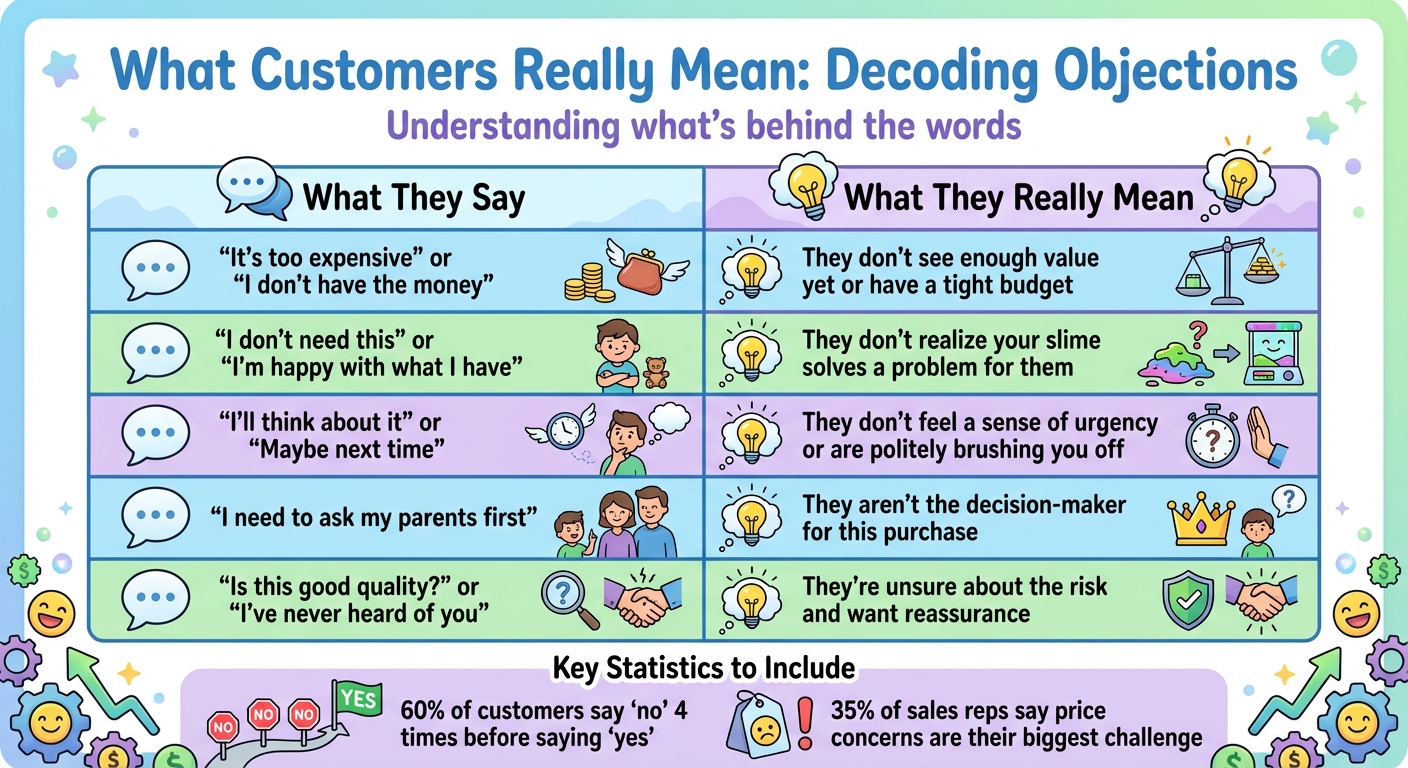
Running a slime business means you’ll hear certain objections over and over. Here’s a quick look at some common ones and what they might really mean:
| What They Say | What They Really Mean |
|---|---|
| "It's too expensive" or "I don't have the money" | They don’t see enough value yet or have a tight budget. |
| "I don't need this" or "I'm happy with what I have" | They don’t realize your slime solves a problem for them. |
| "I'll think about it" or "Maybe next time" | They don’t feel a sense of urgency or are politely brushing you off. |
| "I need to ask my parents first" | They aren’t the decision-maker for this purchase. |
| "Is this good quality?" or "I've never heard of you" | They’re unsure about the risk and want reassurance. |
For example, if parents are concerned about safety, it’s an opportunity to explain why your slime is non-toxic and safe to use. Addressing these concerns can build trust and confidence in your product.
As sales guru Brian Tracy puts it:
"Treat objections as requests for further information."
When a customer raises an objection, it’s not a rejection - it’s a chance to provide the information they need to feel confident in their decision.
Basic Strategies for Handling Objections
Handling objections effectively starts with mastering three straightforward strategies: listening, acknowledging, and responding thoughtfully.
The first step is to listen without interrupting. When someone raises a concern, resist the urge to jump in with a solution right away. Let them finish speaking. This not only demonstrates respect but also makes the person feel heard and valued.
Once you've listened, move on to acknowledge their concern by paraphrasing. For instance, if a customer says, "I'm not sure about the quality", you could reply, "So you're wondering if the product will hold up well over time?" This simple act of restating their concern shows you’ve understood them and helps build trust.
Next, ask clarifying questions to dig deeper into their concerns. Open-ended questions like, "What makes you feel that way?" or "Can you tell me more about that?" can uncover the real issue. For example, a comment like "It's too expensive" might actually mean, "I don't see the value for the price."
The third strategy is the Feel-Felt-Found method, a classic approach to easing worries and highlighting benefits. Here’s how it works: First, empathize with their concern ("I understand how you feel about the price"). Then, show they’re not alone by sharing a relatable experience ("Others felt the same way initially"). Finally, explain what they discovered ("But they found that it was well worth it because the product lasted much longer than expected"). This method transforms objections into collaborative discussions rather than confrontations.
After addressing the concern, always follow up with a question like, "Does that answer your concern?" This ensures the customer feels satisfied and ready to move forward. As sales coach Niraj Kapur wisely notes:
"An objection shows that the prospect is not ready to buy and you need to build more trust."
How to Handle Specific Objections
Building on the strategies of listening and asking the right questions, let’s tackle some specific objections you might face when selling your slime kit. These objections aren’t roadblocks - they’re opportunities to show why your kit is worth it.
When Someone Says 'It's Too Expensive'
When someone mentions the $39.95 Starter Kit is too pricey, they’re essentially asking, “Why is this worth my money?” Price objections are a request for more value.
Start by acknowledging their concern, then highlight what they’re getting. The kit includes 20 pre-made slimes, glitter, charms, marketing flyers, and a sales tracker. Plus, selling each slime for $5 can generate up to $100, easily covering the cost of the kit.
You could say: "I get that the price seems high. A lot of kids felt the same way, but once they sold all 20 slimes at $5 each, that would be $100 in sales. Unlike most toys that just sit on a shelf, this one helps you earn money." You might also ask, "Is it the upfront cost that concerns you, or are you unsure if you’ll make the money back?". This helps uncover their real hesitation.
Don’t let the first “no” stop you.
When Someone Says 'I Don't Need It'
This objection often masks a deeper concern or a lack of understanding about the kit’s value. Start with open-ended questions like, "What do you usually look for in a fun activity?" or "Have you ever thought about starting your own small business?". If they mention liking art, emphasize the kit’s customization options with colors and decorations. If they’re interested in earning money, focus on the business skills and profit potential.
You can also use the Feel-Felt-Found method: "Many people didn’t think they needed it at first, but they found it teaches real business skills like profit-tracking and marketing."
When Someone Says 'I'll Think About It'
When someone says they need to think it over, it often means they’re unsure about something specific. Ask questions to identify their hesitation: "What’s making you unsure?" or "Is there something you’d like to know more about?".
Share a quick success story to address their doubts: "One kid I spoke to felt the same way, but when I explained the kit includes everything - even flyers and thank-you cards - they realized how simple it was to get started."
You can also create a sense of urgency by sharing your goal: "I’m aiming to sell five kits this week to fund my next project. Would it help if I checked back with you on Saturday?". This keeps the conversation alive and shows your commitment.
When Someone Says 'My Parents Won't Let Me'
This objection usually means the customer isn’t the final decision-maker. Your job is to help them explain the kit’s value to their parents.
Ask questions like, "What do you think your parents might be worried about?" or "What information would help them feel more comfortable?". Then, offer parent-friendly details: the My Lil Startup Slime Business Kit uses non-toxic materials and teaches essential skills like marketing and profit-tracking.
You could also offer support: "Would it help if I gave you a flyer to show them? It explains how the kit helps you make money and learn business skills." Or try this: "Other kids felt the same way, but once they showed their parents the included business plan, their parents were excited to help." Always set a follow-up: "When do you think you’ll talk to them? Can I check back with you on Saturday?".
When Someone Asks 'Do You Have Different Colors?'
This isn’t an objection - it’s a sign they’re interested! Questions like this show they’re already imagining themselves using the kit.
Respond with enthusiasm: "That’s the best part! The kit includes glitter, charms, beads, and even glow powder. You can create slimes in all kinds of colors and styles. Every slime can be completely different!".
You can also keep the conversation going by asking, "What’s your favorite color?" or "Do you like sparkly or glow-in-the-dark slimes better?" Then tie their answer back to the kit: "Perfect! With everything included, you can make exactly that kind of slime - and 20 more to sell."
Practice Activities for Objection Handling
The best way to face objections with confidence is to practice handling them before you're in real conversations with customers. Rehearsing your responses until they feel second nature can make a huge difference.
Objection Bingo
Turn objection handling into a fun challenge with a bingo game. Create a bingo card and fill the squares with common objections like "It's too expensive", "I don't need it", "Let me think about it", "My parents won't let me", or "I'm happy with what I have." Add squares for response techniques too, such as "Ask a follow-up question" or "Share a success story." Practice with a friend or family member, marking off a square each time you successfully handle an objection. To keep it exciting, offer small rewards for getting five in a row. Once you've mastered the basics, take it up a notch by role-playing dynamic scenarios to refine your skills even further.
Role-Playing with Friends or Parents
Simulate real sales situations by practicing with a parent or friend acting as a customer. Use tools like marketing flyers or thank-you cards from your My Lil Startup kit to make it feel authentic. Try the "Hot Seat" drill, where your partner throws rapid-fire objections at you for one minute, helping you develop quick and confident responses. Another fun exercise is the "Yes, And" game, where you respond to every statement with "Yes, and..." to keep the dialogue flowing naturally. You can also practice the "That's Exactly Why" pivot - when someone says, "I'm too busy", respond with, "That's exactly why we should talk - to save you time!" These role-playing activities create a safe space to experiment and learn without the pressure of real-world consequences.
Question-Only Games
Once you're comfortable with live practice, challenge yourself with question-only games to sharpen your listening and inquiry skills. In these games, you can only respond to your partner's statements with questions. For example, if they say, "It's too expensive", you might ask, "What price were you expecting?" or "Have you considered how much you could earn back?" This approach encourages you to listen closely and uncover the root of their concerns. Remember, great sales conversations rely more on listening than talking. You can also try the LAER method: Listen, Acknowledge, Explore (using questions), and Respond. This four-step process helps you dig deeper into objections and address them effectively.
Tracking Your Progress
Every conversation with a customer is a chance to learn something new. The sales tracker included in the Growth Bundle ($59.95) and Mogul Bundle ($99.99) from My Lil Startup is designed to help you improve with every interaction. Think of it as your personal coach, helping you identify patterns, sharpen your responses, and build confidence over time.
How to Use the Sales Tracker
Right after each conversation, jot down three key details: the objection raised, how you responded, and the outcome. This simple habit can reveal which objections pop up most often and which of your responses are actually closing deals.
"Analyze past lost deals. The reasons prospects gave you are your goldmine." - Sales Guy, MySalesProcess
To make this even easier, group objections into categories like Budget, Need, Trust, and Urgency. If you notice that price objections come up frequently, you'll know exactly where to focus your energy. Use your tracker to spot these trends and refine your approach during review sessions.
Weekly Review Sessions
Dedicate some time each week - maybe a quiet Sunday evening or Saturday morning - for a focused review of your tracker. Sit down with a parent or mentor and go over what worked, what didn’t, and what felt off. Highlight responses that led to success and role-play improved answers for objections that tripped you up. Practicing each new response out loud three times ensures it feels natural and confident rather than rehearsed. These weekly reviews are all about fine-tuning your skills and building self-assurance.
As a fun incentive, the My Lil Startup kit includes a sealed envelope you can only open after you’ve tracked your way to $50 in sales. It’s a small reward for a big milestone. Remember, the goal of tracking isn’t perfection - it’s progress, one conversation at a time.
Conclusion: Building Confidence Through Practice
Mastering objection handling is about much more than making a sale - it’s about developing life-long skills. Every time a child listens carefully, asks thoughtful questions, and works through a "no", they’re honing emotional control, problem-solving abilities, and communication skills.
Objections aren’t dead ends - they’re openings to understand someone better. When kids learn to shift their perspective, they stop seeing pushback as rejection and start viewing it as a chance to guide someone toward the right decision. This mindset shift transforms every objection into a stepping stone for growth.
"Each objection is an opportunity to deepen your understanding and refine your approach." - Mary Beth Berry, Sales Leader
The confidence kids build at their slime stand doesn’t just stay there - it carries over into their daily lives. The same skills they use to handle a "too expensive" objection - like empathy, asking clarifying questions, and staying persistent - apply to challenges at school, at home, and with friends. Whether it’s negotiating chores with parents or resolving a disagreement, these experiences teach calmness, critical thinking, and adaptability.
Starting a slime business with My Lil Startup gives kids a chance to practice these skills while earning money and building confidence. The kids who thrive aren’t the ones who quit after hearing "no" the first time - they’re the ones who keep learning, improving, and growing with each conversation.
FAQs
How can kids handle objections about price when selling their products?
Price objections can sometimes feel challenging, but they’re actually a great chance to highlight the value of what you’re offering. The key is to stay calm and approach the conversation with curiosity. Try asking friendly, open-ended questions like, “What makes the price feel high to you?” or “What would make it feel worth it?” These questions help you understand their hesitation and shift the conversation from cost to value.
Once you’ve got a sense of their concern, focus on explaining the benefits in a way that resonates. Let’s say you’re selling a Slime Business Kit. You could share something like, “I totally understand - other kids felt the same way at first. But they quickly realized they could sell slime to friends and family.” Then, point out that the kit has everything they need to kickstart a fun, profitable business: pre-made slimes, marketing flyers, and even a sales tracker. Highlight the practical skills they’ll gain, like budgeting, creativity, and building confidence. Framing it as an investment rather than just an expense can make a big difference.
Lastly, you can offer a smaller, low-commitment option to ease their decision. For instance, suggest starting with the Starter Kit for $39.95, with the option to upgrade later if they love it. This approach not only makes saying "yes" easier but also shows that you’re flexible and considerate of their concerns. By focusing on value, relatable benefits, and flexible options, you can turn a hesitant “It’s too expensive” into an excited “Let’s go for it!”
What is the Feel-Felt-Found method and how does it help with objections?
The Feel-Felt-Found method is a straightforward way to address objections while showing empathy and understanding. Here's how it works: First, you acknowledge the other person's feelings about the situation, letting them know their concerns are valid. Next, you share that you (or others) have felt the same way in similar circumstances. Finally, you explain what you or others have found as a solution to the issue.
This technique helps build trust and demonstrates that challenges can be resolved, making it easier to navigate the conversation with confidence.
Why is role-playing important for practicing objection handling?
Role-playing is an engaging way for kids to sharpen their objection-handling skills. It transforms challenging sales conversations into a fun, hands-on practice session. By acting out scenarios - like taking turns as buyer and seller - kids can encounter typical objections, such as “It’s too expensive” or “I need to think about it.” This allows them to try out confident and friendly responses in a safe environment. Over time, they begin to view objections as chances to better understand the buyer’s needs rather than hurdles to avoid.
Another benefit of role-playing is the immediate feedback it provides. After each round, kids can discuss what went well, what could be improved, and how to tweak their tone or approach. This reflective process helps them build essential skills like active listening, empathy, and flexibility. With consistent practice in a low-pressure setting, they can shift from feeling nervous to feeling prepared, tackling real-world sales conversations with creativity and confidence.