

Pricing digital products for kids' businesses is all about finding the right balance between affordability and perceived value. Set prices too low, and customers might doubt the quality. Go too high, and they may hesitate to buy. The key is to price based on value delivered, not just production costs.
Key Takeaways:
- Start with Value: Focus on the transformation or benefit your product offers, like teaching skills or saving time.
-
Choose a Pricing Model:
- Cost-Based: Cover expenses + profit margin.
- Competitor-Based: Research similar products and price competitively.
- Value-Based: Price based on the benefit to the customer.
- Offer Tiers and Bundles: Create options like Basic, Standard, and Premium tiers or combine products into bundles to increase appeal and revenue.
- Test and Adjust: Start with lower prices, gather feedback, and refine as needed.
Even small pricing changes can significantly impact profits. A thoughtful strategy ensures your product is both appealing and profitable.
How to Price Your Digital Products (& Blow up your sales)
How to Determine the Value of Your Digital Product
The value of a digital product lies in the transformation it promises, not the time or effort spent creating it. For instance, a simple tool that helps a child track their first sales can often be more impactful - and valuable - than a detailed guide that ends up unused.
To set the right price, focus on the clear outcomes your product delivers. Does it teach money management? Improve marketing skills? Save time for busy parents? These tangible results justify the price tag and resonate with families looking for meaningful solutions. Take the example of Maria, a photography instructor, who transformed her $47 basic course into a $397 "Professional Certification Program" in 2025.
"The market rewards value, not effort. Price for the transformation you deliver, not the time you invested." - Alva Digital Downloads
Beyond the promise of transformation, consider how your product helps users build practical skills.
Skills and Creativity Development
Products that teach essential skills often command higher prices. Tools like sales trackers, marketing flyers, and business planners not only solve immediate problems but also nurture abilities like communication, financial independence, and problem-solving. Take Carson Kropfl, for example. At just 11 years old, he created the "Locker Board", a skateboard designed to fit inside school lockers. By selling it for $20 each at school and growing his Instagram following to over 300 in a single night, he proved the value of his idea.
Blending learning with fun can also boost a product’s appeal. Digital escape rooms, for instance, encourage critical thinking while keeping kids entertained. Products that help children gain independence - or even earn their own money - are especially appealing to parents. As Tucker Schreiber, former CEO of Combo, explained:
"Being able to prove that you've been through the ups and downs of building a business and making money on your own is incredibly valuable..."
While skill-building is a strong selling point, parents also weigh factors like everyday practicality and financial potential.
What Parents Look for in Digital Products
Parents prioritize products that offer educational benefits and foster independence. They often ask: Will this teach my child something meaningful? Will it encourage independence? Can my child actually make money with this? These considerations heavily influence their purchasing decisions.
Time-saving features are another big draw. For instance, a flyer template that saves hours of work instantly increases its perceived value. If a digital product enables a child to generate $400 or more in a year, it’s seen as a legitimate business tool.
Professional presentation also plays a critical role. High-quality previews, clear instructions, and polished marketing materials can make or break a product’s success. Parents are more likely to invest in a product that feels well-crafted and thoughtfully designed. Meeting these expectations helps justify a higher price point and supports the growth of kids' businesses.
3 Pricing Models for Digital Products
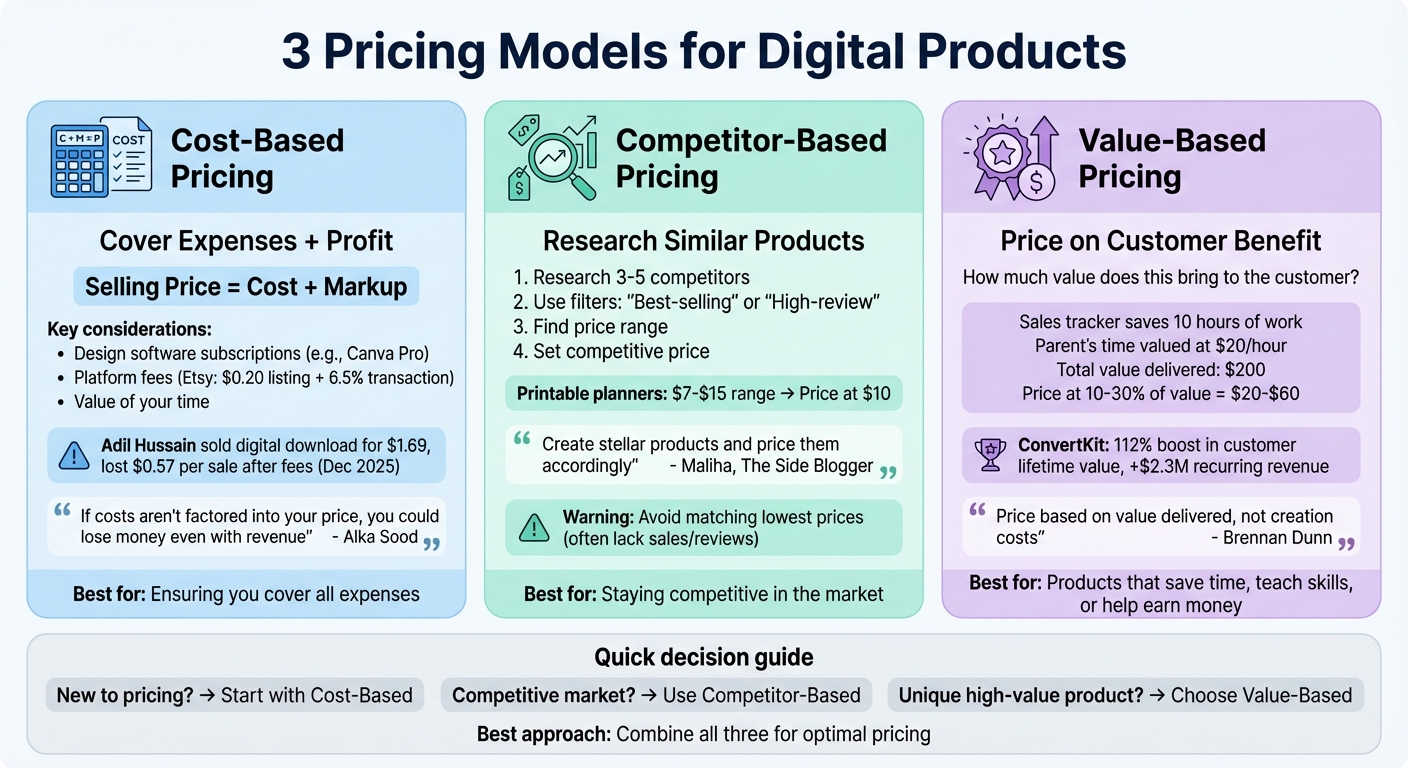
3 Pricing Models for Digital Products: Cost-Based, Competitor-Based, and Value-Based Comparison
Picking the right pricing model is a game-changer for any kids' business. It’s all about finding that sweet spot between affordability and profitability. Each pricing approach offers a unique way to determine what to charge, helping young entrepreneurs make smart decisions.
Cost-Based Pricing
Cost-based pricing is straightforward: add up all the expenses involved in creating your product and tack on a profit margin. The formula is simple: Selling Price = Cost + Markup. For digital products, this means accounting for things like design software subscriptions (think Canva Pro) and platform fees (like Etsy's $0.20 listing fee and 6.5% transaction fee). Don’t forget to include the value of your time, too - it’s just as important as monetary costs.
Here’s a real-world example: In December 2025, Adil Hussain sold a digital download on Etsy for $1.69. After fees, he ended up losing $0.57 per sale.
"If those costs aren't factored into your price, you could end up losing money even though you have revenue coming in."
- Alka Sood, Business Consultant, BDC
While cost-based pricing ensures you’re covering your expenses, it’s not the only thing to consider. A product’s value often goes beyond just its production cost. That’s where market-based pricing comes in.
Competitor-Based Pricing
Competitor-based pricing takes a look at what others in the market are charging for similar products. It’s a way to ensure your price feels reasonable while still making a profit. The trick is to avoid going too high, which could scare off potential buyers, or too low, which might make your product seem less appealing.
Instead of zeroing in on a single price, aim for a range. Research three to five competitors selling similar items - whether it’s printable planners, coloring pages, or digital stickers. Platforms like Etsy or Gumroad are great for this. Use filters like "Best-selling" or "High-review" to see what customers are actually paying. For example, if successful printable planner packs are priced between $7.00 and $15.00, setting your price at $10.00 can strike a nice balance.
"If the only way to sell something is by making it way, way cheap, then you may as well not create that product at all. Create stellar products and price them accordingly."
- Maliha, The Side Blogger
It’s smart to avoid matching the lowest prices, as those shops often lack strong sales or reviews. If your product includes extras like bonus pages or video tutorials, you can confidently price it higher. But pricing isn’t all about competition - it’s also about the value your product delivers.
Value-Based Pricing
Value-based pricing flips the script by focusing on what the product is worth to the customer. Instead of asking, "What does this cost me?" or "What are others charging?", it asks, "How much value does this bring to the customer?". This approach works especially well for products that save time, teach valuable skills, or help customers make money.
Here’s the upside: value-based pricing often allows for higher profit margins since the price isn’t tied to production costs. For example, if a $50 sales tracker template saves a parent 10 hours of work (valued at $20 per hour), the actual value delivered is $200. A common rule of thumb is to set the price at 10% to 30% of that value.
A great example of this in action is ConvertKit, which switched to value-based pricing and saw a 112% boost in customer lifetime value, adding $2.3 million in recurring revenue. While this example involves software, the same principle applies to kids’ digital products. If a product helps a child build a business or develop meaningful skills, families are more likely to see it as a worthwhile investment.
"The biggest mistake I see creators make is pricing based on their creation costs rather than the value their product delivers to customers."
- Brennan Dunn, Founder, Double Your Freelancing
How to Create Pricing Tiers and Bundles
Once you've chosen a pricing model, structuring tiers and bundles can sharpen your approach. These strategies let you cater to different customer needs while offering options that feel tailored. Instead of debating, "Should I buy this?", families begin asking, "Which option works best for us?". Here's how to set up pricing tiers and bundles that resonate.
Setting Up Pricing Tiers
The "Rule of Three" is a reliable framework: offer Basic (core features), Standard (best value), and Premium (exclusive extras) tiers. Take Screenflow, for instance. Their video editing software follows this model with pricing at $149 for Basic, $209 for Super, and $299 for Premium. The Premium tier even includes a stock media library worth over $300. Typically, sales break down as 20% Basic, 60% Standard, and 20% Premium.
Even the most affordable tier should deliver the core benefit of your product. This ensures budget-conscious buyers feel they're getting true value. Pay attention to price ratios, too - patterns like 1:2:5 or 1:3:9 create a logical progression that appeals to customers. For example, kids' digital products might use pricing like $9.99 for Basic, $19.99 for Standard, and $49.99 for Premium.
Building Product Bundles
Bundling related items at a combined price is a great way to boost order value while offering customers a deal. For instance, you could package activity books, video tutorials, and bonus templates together to meet a variety of needs. Bundles can increase average order values by up to 2.3 times.
For digital products aimed at young entrepreneurs, you might create bundles like a guidebook paired with marketing templates, sales trackers, and instructional videos. Each component should work seamlessly to help kids build their businesses.
A real-world example? My Lil Startup offers physical bundles for young entrepreneurs. Their Starter Kit ($39.95) includes everything needed to start a slime business. The Growth Bundle ($59.95) adds extras like a tablecloth for a professional setup, while the Mogul Bundle ($99.99) includes a refill kit for ongoing use. You can adapt this logic to digital bundles, ensuring each tier offers clear, incremental value.
Using Comparison Tables to Show Options
A comparison table is a simple yet powerful tool to help customers decide. Highlight features across tiers, and use visual cues like "Most Popular" or "Best Value" to guide buyers toward the middle tier, which often balances cost and benefits. Each step in the tier should add noticeable value - if the jump between Basic and Standard feels insignificant, customers may not see a reason to upgrade.
| Tier Level | Target Audience | Typical Features |
|---|---|---|
| Basic | Budget-conscious | Core digital product (e.g., ebook or PDF) |
| Standard | Majority of buyers | Core product plus bonus guides and video tutorials |
| Premium | High-value seekers | Core product with all bonuses plus 1:1 support or community access |
Keep the options limited - three tiers is usually ideal - to avoid overwhelming customers. Clear distinctions and thoughtful presentation can make all the difference in helping families choose the right option.
Pricing Tips for Young Entrepreneurs
Pricing isn’t set in stone - it can and should evolve as you learn from your customers. For young entrepreneurs, starting with a flexible strategy allows you to refine your approach over time. Here are some practical tips to help you shape your pricing strategy.
Start with Lower Prices and Test the Waters
Launching with an introductory or "beta" price is a great way to gather early feedback and understand how customers perceive your product. For instance, if you’re selling a digital coloring book that seems like it could go for $10, consider starting at $7.99 to attract initial buyers. Once you’ve made some sales, use customer feedback to adjust your pricing.
Martiel Beatty suggests finding a “safe” starting price, then increasing it by 20%. This adjustment helps cover hidden expenses like transaction fees while ensuring a better profit margin. Testing different price points can make a big difference.
Bundle Products to Increase Value
Offering bundles is another effective strategy to boost sales. By grouping related digital products - like combining a guidebook with templates and a video tutorial - you can create a deal that’s hard to resist. For example, if each product is priced at $10 individually, bundling them for $25 instead of $30 gives customers a clear savings while increasing your overall revenue.
Adding a small “bonus” item, such as a checklist or extra template, can make the bundle even more appealing. This approach not only encourages customers to spend more but also enhances the perceived value of your products.
Gather Feedback from Family
Before launching to a larger audience, test your pricing with family members. Parents, siblings, and relatives can act as your first customers, giving you honest feedback on whether your price feels fair. Show them your product and ask questions like, “Does this feel like a $10, $20, or $50 item?” Their input can help you identify the right pricing range for a slime business or lemonade stand.
Getting family feedback also provides a chance to think through costs, like software subscriptions or internet expenses, that might impact your pricing. Once you have their insights, consider whether your product solves a big problem (which could justify a higher price) or addresses a smaller issue (which might call for a lower price). This process turns pricing into a thoughtful decision instead of a guessing game.
Conclusion
A well-thought-out pricing strategy is essential for driving success with digital products. The key is to price based on the value your product offers to customers, rather than just the time or effort it took to create. Whether you aim to cover costs, stay competitive in the market, or maximize customer value, your chosen pricing model should align with your business goals and experience level.
Offering pricing tiers or bundles can provide flexibility for buyers, meeting various budgets while encouraging larger purchases. One of the greatest advantages of digital products is their high profit margins - often ranging between 70% and 90% - thanks to minimal ongoing expenses. This makes them an attractive option, especially for young entrepreneurs looking to start lean.
"The biggest mistake I see creators make is pricing based on their creation costs rather than the value their product delivers to customers." - Brennan Dunn, Founder, Double Your Freelancing
Focusing on customer value, rather than costs, is what separates thriving businesses from those that struggle.
Begin with a straightforward approach, gather feedback from your initial customers, and refine your pricing as you learn what resonates. As markets evolve and customer preferences shift, your pricing should adapt too. Desirae Odjick from Shopify highlights this ongoing process:
"Pricing is not a decision you make once. As market conditions and your business change, you'll likely need to revisit your product prices."
Experimenting with different price points and staying flexible will help you build a business that lasts. Keep adjusting and improving your pricing strategy to ensure it reflects the growing value of your offerings and supports long-term success.
FAQs
How do I set the right price for digital products aimed at kids' businesses?
When setting a price for digital products aimed at kids' businesses, begin by figuring out all your costs - this includes both production and any overhead expenses. Once you have that, add a markup that ensures you’re making a profit. It’s also important to think about factors like educational value, market demand, and how competitors are pricing similar products. This helps you find the sweet spot between affordability and perceived worth.
Your pricing should highlight what makes your product stand out for young entrepreneurs. Whether it’s encouraging creativity, teaching valuable skills, or boosting confidence, the price should reflect these unique benefits. Be ready to tweak your pricing to remain competitive while clearly delivering value to your audience.
What are the advantages of using pricing tiers and bundles for digital products?
Using pricing tiers and bundles is a smart way to appeal to a diverse customer base by providing options that align with varying budgets and preferences. This strategy increases the chances of customers finding a price point that feels right for them, which can ultimately boost your sales.
Bundles, in particular, offer an extra edge by packaging multiple products together at a discounted price. This not only makes the deal more attractive but also gives customers a sense of added value. On the other hand, pricing tiers can subtly guide customers toward upsells. By highlighting the benefits of higher-priced options, you can encourage them to spend more while still feeling like they’re getting a better deal.
How can kids test and improve their pricing strategy for digital products?
Pricing is a process of trial and discovery. Start by choosing a baseline price for your product, such as $19.99, and experiment with a few alternatives - like $24.99 or $29.99. Test these price points through your website or social media ads for a short window, say one to two weeks, and closely monitor key metrics like sales, customer feedback, and average order value.
Once you identify a pattern, adjust accordingly. For instance, if the lower price drives more sales but leaves thin margins, try a mid-range price and sweeten the deal with extras, like bonus features or small freebies, to boost perceived value. On the other hand, if the higher price is well-received, think about offering premium bundles that include added perks. Also, keep psychological pricing in mind - prices like $24.99 often feel more attractive than $25.00.
Don’t overlook the power of direct feedback. Use surveys or polls to ask kids what they think about the price and whether the product feels worth it. Combining their insights with your sales data will guide you toward a price that hits the sweet spot between affordability, value, and profitability.